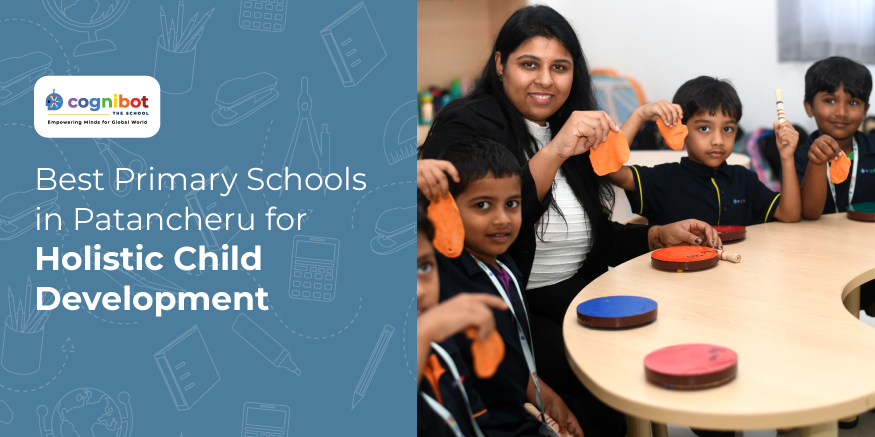
Best Primary Schools in Patancheru: What Holistic Child Development Really Means
Choosing a primary school in Patancheru is not just about comparing buildings, boards, or activity lists. For most parents, the real question is simpler and deeper: will this school help my child think clearly, communicate confidently, stay curious, and enjoy learning every day?
Holistic child development is not only about academics, activities, and facilities. It is about how a school builds conceptual clarity, emotional regulation, communication fluency, creativity, resilience, physical confidence, and independent learning habits during the primary years.
At Cognibot - The School, primary education is built around this idea. Children need strong academics, but they also need emotional confidence, problem-solving skills, movement, creativity, and a learning environment that respects their pace.
Looking Beyond Just Academics
A child learning to ask questions without fear. Trying something new without worrying about being wrong. Sitting with a problem a little longer instead of rushing to answers. These are early signs of independent learning.
In a primary classroom, this may look like children comparing two ways to solve a math problem, using blocks to understand patterns, keeping a simple observation journal after a nature activity, or discussing why a story character made a certain choice. These moments help children move from passive listening to active thinking.
For parents comparing the best primary schools in Patancheru, the curriculum matters because it shapes how children learn, not just what they learn. A Cambridge-inspired learning approach gives space for inquiry, discussion, application, and independent thinking.
The Role Of Environment
Sometimes, what shapes a child the most is not what is taught, but where they are learning. A calm classroom, open spaces to move, and areas where children can build, play, and learn. These things sound simple, but they change how a child feels throughout the day. On some days, a classroom may have children working with blocks, picture cards, clay, books, or simple science materials. On other days, learning may move to the playground, an activity area, or a discussion circle. These shifts matter because young children do not learn only by listening. They learn by touching, moving, comparing, asking, and repeating.
This is experiential learning in its simplest form. Children build understanding through direct experience before they are expected to explain it in words or write it in notebooks.
At Cognibot - The School, we’ve spent a lot of time thinking about this. Our spaces, from activity zones to sports areas, are designed not just for use, but for experience. A child should feel like moving, touching, and experimenting. A mobile-free environment is also part of this thinking. In the primary years, attention is still developing. When children are given screen-free time to speak, observe, play, build, and listen, they slowly develop focus, patience, and social awareness.
Teachers Who Do More Than Teach
Another thing that quietly defines a school is its teachers. Not just qualifications or experience, but how they interact with children in small moments, like the tone of voice, the patience, or the ability to listen. We at Cognibot - The School put a lot of thought into this. Our faculty is not just selected, but carefully reoriented to align with how children actually learn today. Because teaching is no longer about giving information. It’s about guiding thinking. A child who feels understood will naturally start learning better. It’s not forced. It just happens.
A strong primary teacher also helps children develop metacognition, the ability to think about their own thinking. This may happen when a teacher asks, “How did you solve this?”, “What confused you?”, or “What could you try next?” These questions help children become more aware of how they learn.
Learning That Connects To The Future
There’s also this growing thought in many parents’ minds: What will the future even look like for children? It’s a fair concern. The world is changing fast. In an AI-shaped world, children will need more than fixed knowledge. They will need cognitive flexibility, communication skills, interdisciplinary thinking, learning agility, and the confidence to adapt when familiar answers no longer work.
From “what should my child study” to “how should my child think”. At Cognibot - The School, this is where our Sampoornatha approach comes in. It’s not just a program, but a way of looking at development as a whole. Children are not prepared for one path. They are prepared to adapt. They learn things like critical thinking, emotional awareness, communication, and problem-solving, not as separate subjects, but as part of everyday learning. Because in the end, knowledge keeps changing. But the ability to learn stays.
Through everyday classroom tasks, group work, reflection, movement, and creative activities, children begin building future-ready competencies: problem-solving, emotional awareness, collaboration, resilience, and independent thinking.
Activities That Build Confidence, Teamwork, And Expression
Extracurricular activities are often mentioned everywhere, but their real value is sometimes misunderstood. It’s not about how many activities are offered. It’s about whether children are actually discovering something through them. Sports teach patience and teamwork in ways that classrooms cannot. Arts allow expression when words fall short. Even simple games help children learn focus and decision-making.
A football game may teach a child how to recover after losing. A dance session may build rhythm, memory, and stage confidence. A chess game may strengthen patience, planning, and decision-making. An art activity may help a child express an idea before they have the words for it.
We at Cognibot - The School try to give children enough space to explore these naturally. Whether it’s on a large playground, in a dance studio, or during a quiet chess game, each experience adds something. And slowly, children begin to understand what they enjoy, what they’re good at, and what they want to try again.
A Curriculum That Doesn’t Feel Heavy
The curriculum also plays a role, but not in the way it’s usually discussed. It’s not just about what is taught, but how it feels to the child. Our learning approach draws from globally recognised international and British curriculum practices, where children are encouraged to question, discuss, observe, and apply ideas instead of only memorising them.
Children are encouraged to think, question, and connect ideas instead of memorising them. For parents looking for the best primary schools in Patancheru offering the Cambridge curriculum, this is often an important point. Because such frameworks don’t rush learning. They build it step by step, in a way that actually stays with the child.
Questions Parents Should Ask Before Choosing A Primary School
Before choosing a primary school, parents can look beyond brochures and ask questions that reveal how learning actually happens.
Questions can include:
- Does the school encourage inquiry-based learning?
- Are children given enough space for sports, arts, and play?
- How do teachers support different learning speeds?
- Is the curriculum activity-based or only textbook-led?
- How does the school build communication and confidence?
- Are children learning values, independence, and responsibility?
Where Small Habits Turn Into Lifelong Traits
It’s often the smallest daily habits that stay the longest with a child. The way they greet others, how they handle mistakes, and how they stay curious even when something feels difficult. We at Cognibot - The School keep coming back to these quiet details. Because over time, these little patterns slowly shape how children think, behave, and find their place in the world beyond school.
Final Thoughts
The right primary school should help children build strong academic foundations while also developing communication, creativity, emotional balance, physical confidence, and future-ready thinking. For parents comparing primary schools in Patancheru, the real question is not only which school has the longest list of facilities. It is which environment helps children become confident learners, thoughtful classmates, and adaptable thinkers.
At Cognibot - The School, holistic development is built through daily experiences: classroom inquiry, hands-on learning, teacher guidance, play, movement, creativity, and reflection.