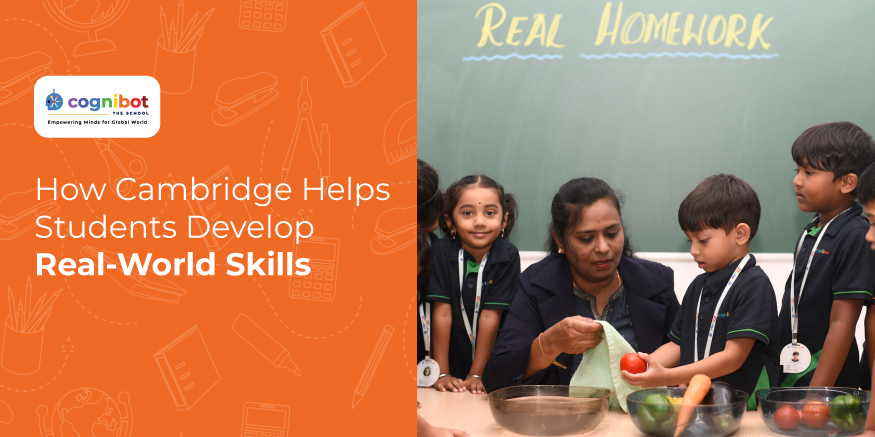
How Cambridge Curriculum Helps Students Develop Real-World Skills
The Cambridge international curriculum is valued by many parents because it helps children move beyond memorised answers and develop real-world skills. These skills are built through inquiry-based learning, classroom discussions, presentations, collaborative projects, experiments, and hands-on problem-solving. At Cognibot The School, the Cambridge curriculum is approached as a way to help children think clearly, communicate confidently, and apply knowledge in everyday situations.
What Real-World Skills Mean In The Cambridge Curriculum
In the Cambridge curriculum, real-world skills are developed when students learn to question, investigate, explain, and apply what they know. A child may build communication skills through a class presentation, cognitive flexibility during a design challenge, resilience during an experiment that does not work the first time, and independent thinking while solving a problem without step-by-step instructions. These are not separate from academics. They are part of how meaningful learning happens.
Learning That Feels Like Real Life
It’s easy to say “real-world skills,” but it’s harder to point to what that actually looks like in a classroom. Sometimes it looks like children working together and disagreeing, then figuring out how to agree again. Sometimes it’s about solving a problem without being given the exact steps. And sometimes it’s just about paying attention.
The structure of Cambridge curriculum subjects allows this to happen without forcing it. English isn’t just reading. Math isn’t just numbers. Science isn’t just facts. Everything overlaps a little, like it does in real life. At Cognibot The School, we notice that when learning feels connected, children stop asking, “Why do we need this?” It stops feeling like school and starts feeling like understanding.
Curiosity Is Not Treated As A Distraction
Inquiry-driven learning begins when a child’s question is taken seriously. A simple question about rain can lead to observing clouds, tracking weather changes, measuring rainfall, drawing patterns, and presenting findings to classmates. In this process, children are not just receiving information. They are learning how to investigate, compare, explain, and reflect.
This is one reason many parents exploring Cambridge schools in Hyderabad look for classrooms where curiosity is not silenced, but structured into deeper learning.
Skills That Don’t Look Like Skills
There are things children learn that don’t show up on report cards easily. These are the early signs of communication, collaboration, metacognition, and resilience. A child learns to understand their own thinking, adjust when an idea does not work, and express a thought clearly enough for others to follow.
Like waiting for their turn to speak, or explaining an idea so someone else understands it, or even just staying with something difficult a little longer than they want to. These are not labelled as “subjects,” but they sit quietly behind everything else. At Cognibot The School, we see this during simple activities. A group project, a storytelling session, or even free play. These moments build something steady inside children. Something that doesn’t fade when the syllabus changes.
The Role Of Environment
It’s not just what is taught. It’s how it feels to learn. A space that allows mistakes without embarrassment changes how a child approaches everything. A classroom that doesn’t rush answers creates room for thinking. We try to keep things simple. Screen-free spaces. Hands-on materials. Conversations that don’t feel like instructions. It’s not about removing technology completely, but about making sure it doesn’t replace thinking. Being among the best Cambridge curriculum schools in Hyderabad often gets measured by results, but the environment behind those results matters more than it seems.
Early Years Shape More Than Expected
There’s a tendency to think serious learning starts later. But the early years quietly shape everything. The way a child learns to ask questions. The way they react when they don’t understand something. The way they express themselves. For example, a storytelling session can become a speaking activity, a sequencing exercise, and a confidence-building moment. A simple block-building task can introduce balance, measurement, teamwork, and problem-solving. These are small activities, but they build the habits children need for later academic learning.
Our Early Years Programme at Cognibot The School doesn’t try to “prepare” children in the traditional sense. It focuses on building comfort with learning itself. Through play, exploration, and simple discovery. In places like the AI Lab or during storytelling, the goal isn’t to impress. It’s to engage. To let children feel that learning is something they can be part of, not something done to them.
When Subjects Feel Connected
One thing that stands out in the Cambridge approach is how subjects don’t sit in isolation. A lesson in science might turn into a conversation in language class. A math activity might connect to something observed outside. This kind of integration makes learning feel less like separate boxes and more like a continuous experience. At Cognibot The School, we see this often during project-based learning. Children don’t always realise they are switching between subjects. They are just trying to understand something fully. That, in a way, feels closer to real life than any structured lesson.
Confidence Builds Over Time
Confidence becomes visible through behaviour. Children begin to raise their hands more often, explain answers with reasons, present ideas to classmates, ask follow-up questions, and try again after mistakes. These are the outcomes parents can notice over time: stronger communication, independent thinking, resilience, and a willingness to participate.
What Stays Beyond School
The real value of an international curriculum is not only in what children study, but in how they learn to use knowledge. Long after a chapter is forgotten, a child may still carry the habit of asking better questions, testing an idea, listening before responding, and thinking across subjects.
Why Parents Look For Cambridge Schools In Hyderabad
Many parents searching for Cambridge schools in Hyderabad are looking for more than an international curriculum. They want a learning environment that supports conceptual understanding, inquiry-based learning, communication, creativity, and future readiness. The Cambridge curriculum gives schools a structure where children can explore ideas, apply concepts, and build confidence through active learning instead of depending only on memorisation.
Final Words
Real-world skills are not separate from education. They are built through the way children learn every day. When students question, collaborate, present, observe, build, reflect, and try again, they begin developing habits that stay with them beyond school. At Cognibot The School, the Cambridge curriculum is approached with this belief: children should not only learn for exams, but also learn how to think, communicate, and respond to the world with confidence.