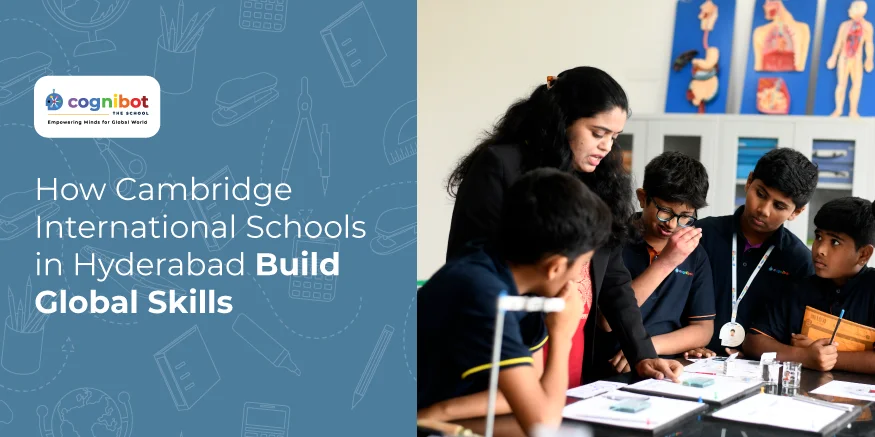
How Cambridge International Schools in Hyderabad Build Global Skills
When people talk about schools today, the conversation usually goes straight to marks, exams, and careers. But that feels incomplete now. The world children are growing into is changing too quickly for education to stay limited to textbooks alone. That is probably why many parents have started looking at Cambridge international schools in Hyderabad a little differently. Not because they sound international, but because they seem to prepare children for situations that cannot always be predicted.
At Cognibot The School, we often think about this in a very practical way. A child may learn formulas and facts, but can they solve problems calmly? Can they communicate clearly? Can they adapt when things change? Those questions matter more now than they once did.
What Global Skills Really Mean
The phrase "global skills" can sound larger than it needs to be. It is not only about speaking fluent English or studying abroad one day. It is usually smaller and more human than that. It means learning how to think independently. It means understanding different perspectives without becoming confused by them. It means being comfortable asking questions instead of memorising answers just to repeat them later.
That is one reason many families are exploring international curriculum schools in Hyderabad. The learning style tends to focus less on pressure and more on understanding. Children are encouraged to explore ideas instead of rushing through chapters. At Cognibot The School, this thinking shapes the way learning happens every day. The classrooms are built around inquiry, discussion, projects, creativity, and reflection. Even younger children are gently encouraged to ask "why" and "what if," which honestly changes the way they approach learning over time.
Why The Cambridge Approach Feels Different
One thing many parents notice about the Cambridge system is that children do not simply study for exams. They learn how to connect ideas with real situations. The Cambridge curriculum benefits become clearer when children start applying knowledge naturally instead of memorising it mechanically. A science lesson becomes observation and experimentation. Language learning becomes communication. Mathematics becomes reasoning instead of repetition.
At Cognibot The School, the Cambridge Early Years and Primary Programme are designed in a way that keeps curiosity alive. There is play-based learning in the early years, but it does not feel careless or random. There is structure underneath it, just not the kind that suffocates children. Even small things matter. A mobile-free environment, for example, may sound strict at first. But over time, it creates attention spans that are becoming rare. Children begin listening more carefully, interacting more naturally, and staying present in what they are doing.
Preparing Children For A Future Nobody Fully Understands
There is also another layer to this conversation now, and most parents quietly think about it even if they do not always say it aloud. Artificial intelligence is changing work faster than expected. Entire industries are shifting. At Cognibot The School, this is not treated like a distant problem. The SMAART Programme was created because future careers will demand a different mix of skills. Students are introduced to areas like robotics, coding, artificial intelligence, psychology, cybersecurity, and even space science while they are still young enough to explore without fear.
But what feels important is that technology is not treated as the only answer. The school's SAMPOORNATHA programme spends equal attention on emotional intelligence, leadership, critical thinking, communication, and social awareness. That balance matters. A child who only learns technology may struggle with people. A child who only memorises theory may struggle with change. Real education probably sits somewhere in between.
The Things Children Learn Outside The Classroom
Sometimes schools talk about holistic development in a very polished way, and it starts sounding like a brochure. But children genuinely do learn differently when they move, create, compete, and collaborate outside classrooms. At Cognibot The School, sports, arts, yoga, music, dance, and indoor games are not treated like side activities added for appearance. They are part of how confidence slowly develops.
A child playing football learns teamwork without attending a seminar about teamwork. A child performing on stage learns confidence in a way no textbook can teach. Even chess and billiards quietly build patience and strategy. That is often overlooked while discussing global skills development for students. These skills are rarely formed during lectures alone. They grow during conversations, failures, practice sessions, competitions, and creative work.
Why Cognibot The School Stands Out
There are many schools now claiming to prepare children for the future, which can make the choice confusing for parents. But at Cognibot The School, the approach feels more thoughtful than performative. The school carries forward a 24-year educational legacy while still trying to adapt to modern realities. The infrastructure is large and carefully designed, but what stays in people's minds is usually the atmosphere. There is seriousness about learning without making childhood feel heavy. Teachers appear invested in individual growth, and the balance between academics, creativity, and emotional development gives parents a sense that children are being prepared for life, not only examinations ahead.
The Cambridge framework, the SMAART Programme, the SAMPOORNATHA philosophy, the emphasis on emotional intelligence, the mobile-free environment, and the strong extracurricular culture all seem connected to one larger idea: children should grow into capable human beings, not just high scorers. That is probably why many parents now include Cognibot while searching for the best Cambridge schools in Hyderabad.
Final Words
Maybe the biggest change happening in education is this: people are slowly moving away from asking only how much children can study. They are starting to ask what kind of people children are becoming while they study. That feels like a healthier question. Schools cannot predict the future perfectly. Nobody can. But they can help children become adaptable, thoughtful, curious, and emotionally steady enough to face it. And perhaps that is what many families are truly looking for when they consider Cambridge international schools in Hyderabad today. Not perfection, just an education that feels connected to real life, real change, and the kind of future children will actually step into.