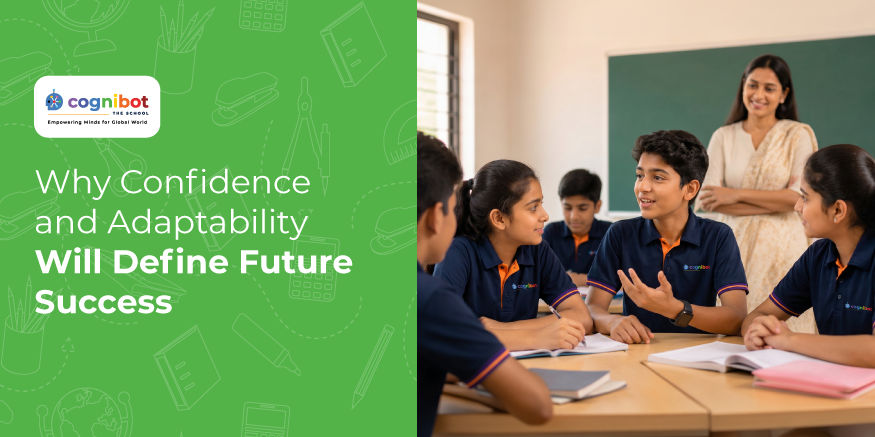
Why Confidence and Adaptability Will Define Future Success
If one asks a successful person how they managed to find their path through life’s journey, very rarely will they mention an individual fact they had committed to memory back at school. On the contrary, most likely, they will refer to times when they were in doubt, a period after they experienced defeat, or a completely new situation that they had to handle.
Such situations do not rely on the possession of knowledge alone. Understanding why confidence and adaptability are important for success – two things that have gained much attention in today’s society, because they have proven to be the main predictors of success. Why confidence and adaptability are important for achieving success is a crucial issue to understand.
Why the World Now Demands These Two Qualities Above Almost Anything Else
Success seemed to follow a fairly linear pattern during most of the 20th century. All one needed was to gain a certain skillset and apply that consistently in an established sector, and success would come more or less automatically.
This paradigm is far less viable today. Technological changes can revolutionise whole sectors within a matter of years, careers entail multiple turns instead of a linear course, and skills seen as absolutely crucial today could very well be automated out of existence a decade from now.
Under such conditions, the future skills students need to succeed do not revolve around any particular field of knowledge, since the very nature of knowledge changes too rapidly for this kind of connection to become sustainable. Instead, it revolves around the core competency of facing an unfamiliar situation with ease, backing oneself even if the right direction is unknown, and being able to change course in order to cope with the changing circumstances.
It is confidence that allows a person to make the necessary attempts at doing something unfamiliar. It is adaptability that makes them successful in the attempt. Together, they form a far more durable foundation for long-term success than any specific skill set learned in isolation.
What Genuine Confidence Actually Looks Like in Students
Confidence is generally perceived as an individual’s ability to talk or act aggressively. This is not what confidence is all about when one talks about a student’s confidence. Confidence in students can be depicted from an individual who attempts to perform something despite having doubts about achieving success, an individual who receives criticism positively despite not feeling hurt or disappointed, and a student who speaks his/her mind despite conflicting with other people's views.
This type of confidence is earned through successive rounds of doing something difficult, getting feedback on how to improve, and succeeding at it. If the student is consistently told how great they are despite their poor performance, then they do not learn any real confidence; what they learn instead is a self-concept that crumbles the second anything difficult comes along, or any sort of constructive criticism is delivered. Real confidence stems from having a realistic assessment of one’s evolving skill set.
How Schools Can Actually Build This Kind of Confidence
To understand how schools build confidence in students, one must go beyond superficial encouragement into an analysis of the institutional structures that actually allow students to grow.Public speaking and performance experiences, whether in the form of giving a class presentation, participating in a show at the school’s theatre, or competing in athletics, provide students with multiple opportunities to expose themselves in a relatively risk-free setting. Through repetition, this helps to alleviate fear around exposure and performing.
Constructive feedback that comes from mentors who actually understand the development stages of children carries more weight compared to generalised praises that all students get. It is because an individual who knows exactly where he/she performed well and exactly where there is room for improvement will develop a more realistic view about his/her capabilities than someone who is just encouraged in vague terms.
Another means of fostering leadership skills is through the creation of opportunities for students to serve in leadership roles, either through participation in club activities, group project work, or peer mentorship, which provides the students with a chance to have an experience of being entrusted with responsibilities. It is important to note that confidence building activities for students can be most effective when they are part of the normal school routine and not just periodic occurrences.
Developing Adaptability Skills in Children
While confidence relates to the mental preparedness of the student, adaptability refers to the practical ability of the individual to react appropriately when faced with a situation where everything is not planned.
It is necessary to subject young learners to environments where the outcome is not predefined for developing adaptability skills in children. Adaptability cannot be built through learning or memorisation, both of which reward knowing the one correct response in advance.
Project-based learning, which requires students to solve unclear and open-ended problems instead of having to go through a rigid process, develops such an ability. Being exposed to true interdisciplinarity, where the student gains the ability to relate the various topics together as opposed to approaching them separately, can develop cognitive flexibility, the mental ability to switch perspectives, as necessary.
Collaborative projects that involve negotiation of diverse perspectives, rather than just completion of individual tasks, provide direct and consistent experience for the students in adapting their approaches based on feedback from others.
The importance of being exposed to totally new areas, which can be easily overlooked, cannot be disregarded as well. If a student was previously introduced to subjects like artificial intelligence, genetic engineering, or space science, he or she becomes accustomed to being comfortable with novelty, an innate feeling that unknown territory is meant to be explored rather than feared. Such an attitude, formed at an early age, proves to have a wide application scope.
Why These Two Qualities Compound Each Other
Neither confidence nor adaptability is an unrelated trait that exists separately; rather, they enhance one another such that when used together, their efficacy is multiplied significantly compared to their individual effects.
The fact is, a confident student is less apprehensive about facing those unknowns, which will eventually lead to an improvement in adaptability because of fear of failure; on the other hand, an adaptive student can easily bounce back after facing a few obstacles, as these obstacles come from venturing into areas that were unknown to them before.
This synergy is what makes those who acquire both these traits capable of displaying an extraordinary level of resilience that students possessing only one characteristic find difficult to replicate. Confident yet inflexible students will be able to do brave things, but will find themselves in dire straits when the conditions change suddenly. Adaptable but insecure students will be able to cope well with changes, but will falter at the crucial moment when they need to initiate something. Both of these characteristics, when developed in tandem, result in truly competent people for the unpredictable future ahead.
At Cognibot, we have built confidence and adaptability directly into the structure of how students experience each day, rather than treating them as incidental outcomes of a standard curriculum. Our Trayoda C framework explicitly develops confidence and cognitive flexibility as two of its thirteen core competencies, alongside creativity, adaptability, and independent thinking, through structured worksheets, discussions, and real-world application rather than passive instruction.
Our SMAART program exposes students from Grades 6 to 10 to genuinely unfamiliar and advanced fields, from neuroscience and space science to AI and robotics, building the comfort with novelty that underpins long-term adaptability. And through Sampoornatha, guided daily by mentors trained in child psychology, students are given consistent, structured space to reflect on setbacks, build self-belief, and practise the kind of honest self-assessment that genuine confidence depends on. We believe that preparing students for an unpredictable future means building these capacities deliberately and consistently, not hoping they emerge on their own.
Conclusion
In a world where particular skills can become obsolete faster than ever before, the characteristics that will determine true success in the future will become the very things that cannot be learned by just acquiring information. Confidence will help youth feel the boldness to enter into an uncertain situation, while adaptability will give youth the ability to deal with the uncertainty when in it. The schools that place as much importance on developing confidence and adaptability as they do on teaching their students are the schools that will better equip their students for the unpredictable future to come.