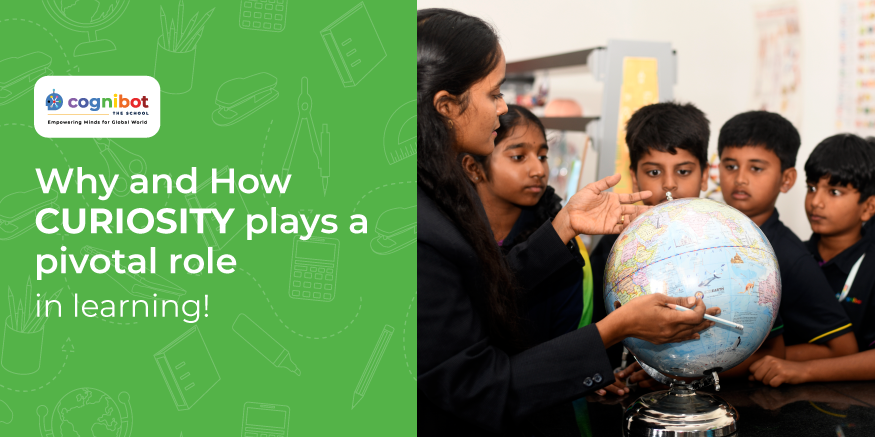
Why and How Curiosity Plays a Pivotal Role in Learning!
Curiosity is the spark that gets kids questioning, ideating, and learning with excitement. Teachers believe that until students become interested, learning doesn't begin at Cognibot – The School.
Cognibot fosters an environment where every child gets the space and confidence to think, ask, and explore. Each classroom, each activity, each experience reflects the importance of curiosity in learning.
Curiosity Makes Learning Interesting
Children learn faster when they are curious. When a student wonders “Why?”, “How?”, or “What if?”, their brain becomes more active and focused. That is the true role of curiosity in learning. Instead of memorising answers, curious students try to understand ideas. This makes education more enjoyable and long-lasting.
At Cognibot – The School, teachers use experiments, hands-on activities, and meaningful discussions to spark learning. Most importantly, they encourage curiosity by posing open-ended questions that prompt students to pause, think, and explore.
Why can we see the moon during the daytime? Why can’t we see the sun at night? If every movement needs energy, where does the Earth get the energy to rotate and revolve continuously? This approach awakens curiosity, critical thinking, and a lifelong love for learning.
Curiosity Builds Confidence
When students explore and find answers on their own, they feel confident. The role of curiosity in learning is not only academic; it helps children build self-belief. A curious child is not afraid of challenges. Instead, they enjoy solving problems.
Cognibot also teaches discipline and responsibility. The school follows a strict no-smartphone rule. Students are not allowed to own or use smartphones at any time, not only inside the school but also outside. Parents fully support this policy because it protects children from distractions and encourages healthy curiosity in the real world.
Students interact more, observe more, and learn more through direct experience, proving the strong importance of curiosity in learning.
Curiosity Encourages Real-World Learning
The world is a huge classroom. The role of curiosity in learning grows stronger when children step outside textbooks and look at real places, people, and events. At Cognibot – The School, students learn through field visits, hands-on projects, and practical tasks.
These experiences show them how knowledge connects to real life. For example, instead of just reading about plants, students visit gardens (and are explained in detail about them). Instead of memorising facts about money, they learn through simple budgeting activities. Because of this approach, curiosity in students' learning increases naturally. Learning becomes fun, meaningful, and memorable.
Curiosity Helps Students Think Better
In today’s world, students must think critically. The curiosity in learning lies in how it trains the brain to ask questions, compare ideas, and look for better solutions. Curious students don’t depend only on teachers or books; they explore independently.
At Cognibot, teachers never stop at giving answers. They ask children to think, discuss, and share ideas. This builds confidence, communication, and creativity. Slowly, curiosity in students' learning turns into a habit that stays with them for life.
A Healthy Body Supports a Curious Mind
Curiosity grows best when children feel healthy and energetic. Cognibot – The School is one of the few schools that strictly avoids junk food. Students are not allowed to eat junk food even outside school.
Parents support this fully because children learn self-control and healthy living. When the body is healthy, the mind stays sharp. This supports the role of curiosity in learning, as active minds think better, explore more, and learn faster.
The School Environment Matters
A child learns more when surrounded by positivity and encouragement. Cognibot creates classrooms where students feel safe asking questions and making mistakes. The school does not judge children for being different. Each doubt, each idea, each question is welcomed.
This shows how deeply a child must be free to explore. Teachers also communicate regularly with parents. Together, they support curiosity in students' learning at home and in school. Parents are encouraged to talk to their children about daily lessons, ask questions, and allow exploration.
Why Curiosity Prepares Children for the Future
The future belongs to thinkers, inventors, and problem-solvers. Students who ask questions will lead tomorrow. This is why the role of curiosity in learning is not just for academics; it prepares students for every part of life.
At Cognibot – The School, learning is not limited to exams or marks. It is about shaping confident, creative, and independent learners. We continue to build futures where curiosity leads to intelligence, responsibility, and success.
Conclusion
Curiosity is the heart of learning. A curious student listens more intently, thinks deeper, and understands better. That curiosity in learning itself speaks of its importance, turning education into an exciting adventure.
Discipline, creativity, real-world experiences, and a supportive environment ensure that the curiosity in students' learning never dies at Cognibot–The School. This is how Cognibot builds learners who are ready for real life: confident, curious, and capable.