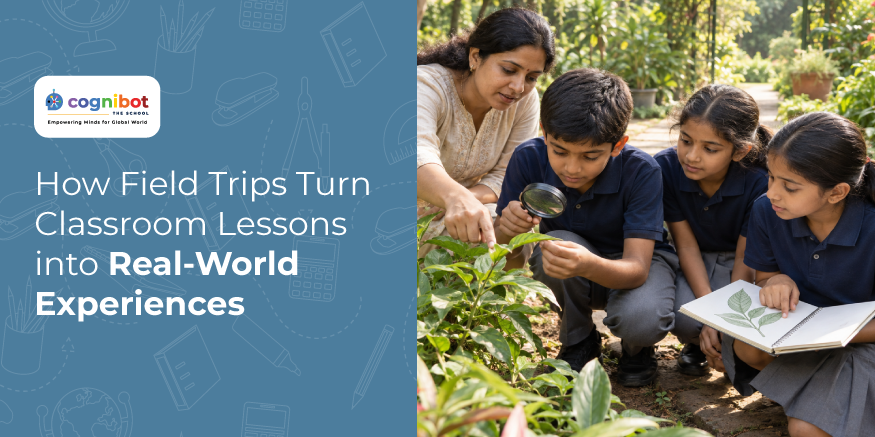
How Field Trips Turn Classroom Lessons into Real-World Experiences
Children do not learn only by reading books or listening to teachers. Some of the best learning happens when they get to see, explore, touch, question, and experience things for themselves. This is where field trips can make a big difference.
A visit to a museum can make history more interesting. A trip to a science centre can make a difficult concept easier to understand. Visiting a farm can help students see how crops are grown, while a trip to a planetarium can make lessons about space feel real.
This is why field trips and experiential learning go hand in hand. Field trips give students an opportunity to take what they learn in the classroom and connect it with the world around them.
What Are Field Trips?
Field trips are planned educational visits where students explore places outside their regular classroom. These can include museums, science centres, historical sites, farms, nature parks, libraries, art galleries, industries, research centres, and other places connected to their lessons.
A field trip is not simply a day away from school. When planned properly, it becomes an extension of classroom learning.
For example, students learning about ancient history can visit a historical monument. Instead of only reading about its architecture, they can see its design, understand its size, and learn about the people and events connected to it.
This makes learning outside the classroom more practical and easier to remember.
How Field Trips Connect Classroom Lessons With Real Life
1. Students Can See What They Learn
Textbooks explain concepts, but real-life experiences can make those concepts easier to understand.
A science textbook may explain how water is cleaned before it reaches homes. During a visit to a water treatment plant, students can see the different stages of the process.
Similarly, a geography lesson about farming becomes more relatable when students visit a farm and observe crops, irrigation, soil, and farming methods.
When students see a concept in action, they can better understand how it works in the real world.
2. They Make Learning More Engaging
Not every student learns in the same way. Some understand concepts quickly through reading, while others learn better through observation and practical activities.
Field trips provide a different way to learn.
Students can explore new places, interact with their surroundings, ask questions, and participate in activities. This can make subjects that seem difficult or boring in a classroom much more interesting.
This is one of the major benefits of field trips for students. They can make learning more active rather than simply listening and taking notes.
3. Students Learn Through Experience
Experiential learning allows students to learn by doing.
Consider a student learning about plants. Reading about roots, stems, leaves, and photosynthesis gives them basic knowledge. But visiting a botanical garden and observing different plants can help them understand those concepts more clearly.
They may notice differences between plants, observe how they grow, and ask questions about their surroundings.
The experience becomes part of the learning process.
This is why field trips and experiential learning can work so well together.
4. Field Trips Encourage Curiosity
A new environment can naturally make children curious.
They may notice something they have never seen before and start asking questions:
Why does this machine work this way?
How was this building constructed?
Why do these plants grow here?
How does this animal survive?
These questions can become opportunities for further learning.
Teachers can use the questions students ask during a trip to start classroom discussions, projects, research activities, and presentations after they return to school.
The Importance of Field Trips in Education
The importance of field trips in education goes beyond making school more enjoyable. Field trips can support academic learning while also helping students develop practical skills.
During a trip, students may have to follow instructions, stay organised, communicate with classmates, manage their belongings, and work as part of a group.
They also learn how to behave in unfamiliar environments and become more comfortable interacting with people and places outside their usual routine.
These experiences can help develop skills that are useful both inside and outside the classroom.
Field Trips Can Make Different Subjects More Practical
Field trips can be connected to almost any subject.
Science
Students can visit science museums, laboratories, nature parks, observatories, or environmental centres. These experiences can support lessons on space, plants, animals, energy, technology, and the environment.
History
Museums, forts, monuments, archaeological sites, and heritage locations can help students understand history beyond dates and textbook information.
Geography
Visits to farms, forests, lakes, rivers, and other natural locations can make topics such as landforms, water resources, agriculture, and climate easier to understand.
Mathematics
Mathematics can also be connected to real-world experiences. Students can explore measurements, distances, shapes, quantities, budgets, and data collection during educational visits.
Art and Culture
Museums, galleries, theatres, craft centres, and cultural spaces can expose students to different forms of art and help them understand the cultural background behind them.
This shows why educational trips for school students can be useful across different areas of learning.
Field Trips Help Build Social Skills
Field trips are also an opportunity for students to interact with their classmates in a different setting.
They may work together on activities, share responsibilities, discuss what they see, or help each other during the trip.
These simple experiences can strengthen communication and teamwork.
Students also get an opportunity to interact with teachers outside the usual classroom environment. This can create a more open learning atmosphere where students feel comfortable asking questions and sharing their thoughts.
How Teachers Can Make Field Trips More Effective
A successful field trip needs more than choosing a destination and taking students there. It should have a clear learning purpose.
Before the trip, teachers can explain where students are going and connect the visit to a topic they are already studying.
During the trip, students can be given simple activities such as:
- Observing specific objects or processes
- Asking questions
- Taking notes
- Completing worksheets
- Recording interesting facts
- Working in small groups
- Comparing what they see with what they learned in class
The learning should continue after the trip as well.
Students can prepare presentations, write short reports, create posters, discuss their experiences, or work on projects based on what they observed.
This helps turn a one-day outing into a complete learning experience.
How Educational Trips Benefit Students
There are several ways educational trips benefit students. They can help children:
- Understand concepts more clearly
- Remember information for longer
- Develop curiosity
- Improve observation skills
- Ask more questions
- Connect lessons with everyday life
- Improve communication
- Develop teamwork
- Become more independent
- Gain exposure to new environments
- Develop problem-solving skills
Perhaps the biggest benefit is that students start to understand that learning is not limited to textbooks and classrooms.
The world around them can also become a classroom.
Cognibot – The School and Experiential Learning
For parents looking for a school that combines academic learning with practical experiences, Cognibot – The School can be a good option.
Cognibot focuses on preparing students for a changing world through critical thinking, creativity, curiosity, and practical learning. Its approach goes beyond books and examinations and includes hands-on experiences as part of learning.
The school also follows an activity-based and experiential approach, where students can learn through activities, experiments, case studies, and practical applications.
Its campus has dedicated spaces such as a science lab, mathematics lab, AI lab, computer lab, physics lab, and library. These facilities give students opportunities to explore concepts practically within the school as well.
Cognibot also offers the Cambridge Curriculum for Nursery to Grade 5 and a proposed CBSE curriculum for Grades 6 to 10, along with programs such as SMAART that include areas like AI, Robotics, and Space Science.
This combination of classroom learning, practical activities, projects, and exposure can help students understand that education is not just about completing chapters. It is also about understanding how knowledge can be used in the real world.
Field Trips Can Create Lasting Learning Experiences
A child may forget a paragraph they read in a textbook, but they may remember standing inside a museum and seeing an object they had only read about.
They may remember watching a science experiment, exploring a planetarium, seeing how crops are grown, or asking a professional about their work.
These experiences can make lessons more memorable because students associate information with something they actually experienced.
That is the real value of educational school trips. They help turn information into experience.
Final Thoughts
Field trips should not be seen simply as breaks from regular schoolwork. When they are connected to classroom lessons, they can become powerful learning opportunities.
They allow students to explore the world, ask questions, observe real situations, and understand how their lessons apply outside the classroom.
Schools that combine academic teaching with practical activities, projects, experiments, and learning outside the classroom can give students a more complete learning experience. Field trips are one part of that approach, helping children learn not just from what they read, but from what they see, do, and experience.