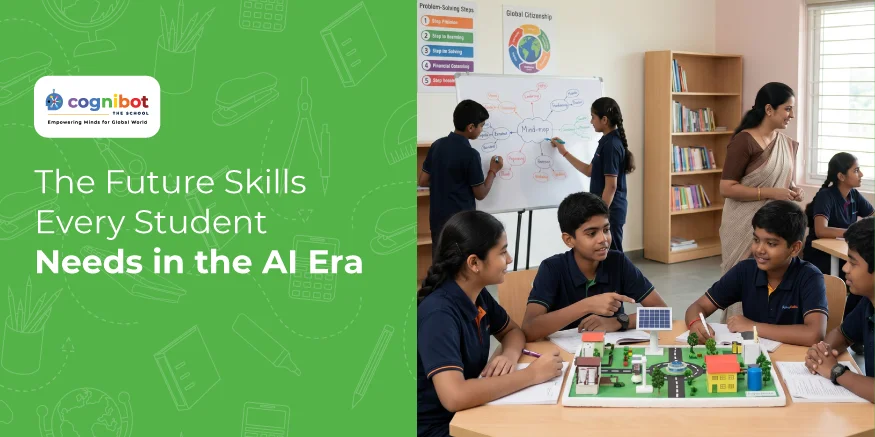
The Future Skills Every Student Needs in the AI Era
There is something strange about raising children in a time when machines can already write, answer questions, create images, and solve problems in seconds. A few years ago, most people thought these things belonged in science fiction. Now they sit quietly inside phones and laptops, slowly changing the way work, learning, and even thinking happen. That is why conversations around future skills for students feel different now. It is no longer only about scoring well or choosing safe careers.
The bigger question seems to be whether children are learning how to think, adapt, and stay human in a world that keeps automating everything around them. At Cognibot The School, we often come back to this thought. If the future itself is changing so quickly, then education cannot stay frozen in older ideas of success.
Learning How To Think, Not Just Answer
One thing becoming clearer in the AI era is that information alone is losing value. Facts are everywhere now. A child can ask AI almost anything and get an instant response. But understanding is different. Children still need to learn how to question things, connect ideas, notice patterns, and make decisions when answers are unclear. These are the quieter skills that do not always appear in report cards, but they shape how someone handles life later.
At Cognibot The School, this idea sits deeply inside our learning approach. Through the SMAART Program and the SAMPOORNATHA framework, students are encouraged to think beyond memorising. Subjects like Robotics, Psychology, Space Science, Data Science, and Artificial Intelligence are introduced not as trends, but as ways to build curiosity and flexible thinking. That may matter more than simply preparing for one fixed profession.
Why Human Skills May Matter Even More
There is also an uncomfortable truth hidden inside discussions about AI. Machines are becoming better at technical tasks very quickly. What they still struggle with is being deeply human. Empathy, emotional balance, creativity, communication, leadership, and judgment still come from people. The conversation around human skills vs AI is not really about competition. It is more about understanding what should never be replaced.
A child who can collaborate well, speak thoughtfully, solve conflicts calmly, and stay emotionally steady may be more prepared for the future than someone who only knows how to follow instructions perfectly. This is one reason why AI-era skills for children cannot be limited to coding alone.
At Cognibot The School, emotional intelligence, social intelligence, leadership, mindfulness, and interpersonal growth are treated as part of education itself. Sports, yoga, expressive arts, music, chess, theatre, and collaborative activities are not seen as distractions from academics. They are part of how children slowly become complete individuals. That balance feels important now.
Attention May Become A Rare Skill
Another thing people do not talk about enough is attention. Children today are growing up in constant noise. Notifications, short videos, endless scrolling, and digital overstimulation are shaping how young minds focus. In the middle of all this, the ability to sit with a problem, think patiently, or read deeply is quietly becoming rare.
At Cognibot The School, the decision to support a mobile-free childhood comes from this concern. There is value in giving children space to observe, imagine, play, speak face-to-face, and stay present without constant digital interruption. Ironically, in a highly technological future, focus itself may become one of the strongest future skills.
Education Cannot Stay One-Dimensional
Many parents still grew up believing education mostly meant textbooks, marks, and examinations. But the future may ask children to move across industries, learn new tools repeatedly, and solve problems that do not even exist yet. That changes what future-ready education should look like. A child learning robotics today may later work in healthcare. Someone studying psychology may collaborate with AI systems. Creative fields may merge with technology in ways nobody fully predicts right now.
At Cognibot The School, the learning environment tries to reflect this uncertainty instead of ignoring it. The Cambridge curriculum, inquiry-based learning, project-based exploration, and interdisciplinary exposure are all designed around adaptability rather than rigid academic pathways. Even extracurricular spaces carry this purpose quietly. Sports develop teamwork and resilience. Music strengthens patience and expression. Chess sharpens strategy. Art encourages imagination. These things may look separate from academics on paper, but real life rarely separates skills so neatly.
How Cognibot The School Sees The Future
At Cognibot The School, the larger goal is not simply producing students who can survive the future. The idea is to help children grow into thoughtful, capable, balanced people who can still think clearly in a fast-moving world. That is why the SAMPOORNATHA Program focuses on areas like critical thinking, creativity, emotional intelligence, financial literacy, leadership, comprehension, and digital awareness together. The SMAART Program introduces students to fields connected to tomorrow's industries while still grounding them in human values and practical understanding.
There is also a belief here that children should not lose their childhood while preparing for the future. Spaces for sports, yoga, arts, movement, conversation, and real-world interaction matter just as much as advanced technology labs. In many ways, this reflects what schools preparing students for the future may increasingly need to become, places where children learn how to live wisely with technology, not depend on it blindly.
Final Words
The AI era can sound exciting one day and unsettling the next. Most adults are still trying to understand it themselves. So it makes sense that parents feel uncertain about what children truly need now. But maybe the answer is not as complicated as it first appears. Children will probably need technical understanding, yes.
They will need adaptability, curiosity, and digital confidence. But they will also need calm thinking, emotional resilience, creativity, empathy, communication, and the ability to work with others meaningfully. Machines may continue getting smarter. That seems unavoidable now. The real question is whether education can help children become wiser, kinder, and more thoughtful while growing alongside that technology. At Cognibot The School, that balance feels worth protecting because the future may not only belong to the most intelligent people. It may belong to the most deeply human ones.