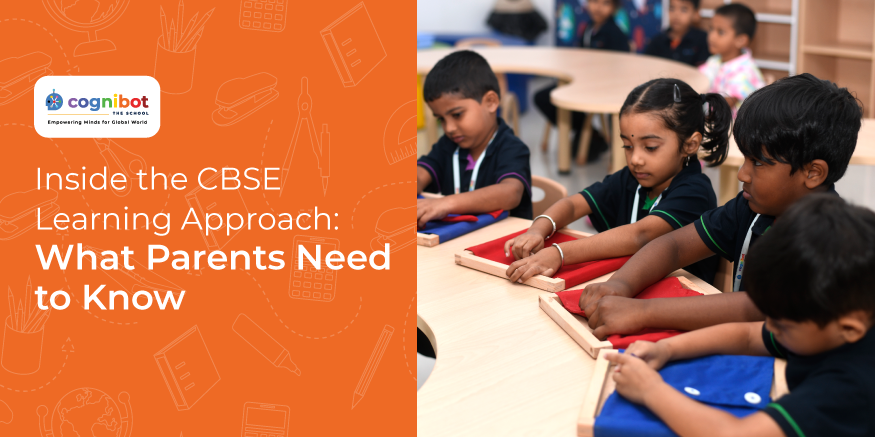
Inside the CBSE Learning Approach: What Parents Need to Know
The CBSE learning approach in India has changed significantly in recent years. While many parents still associate CBSE with textbooks, exams, and syllabus pressure, recent CBSE reforms and NEP-aligned education policies increasingly emphasise competency-based learning, conceptual understanding, application-oriented assessment, and skill development.
The structure is there, yes, but it isn’t meant to box students in. It’s more like a guide that slowly builds habits, reading, questioning, solving, and sometimes even getting things wrong and figuring out why. At Cognibot The School, this is something we’ve spent a lot of time reflecting on. The curriculum itself doesn’t do the teaching. It’s how it is brought to life that matters.
How Modern CBSE Learning Manages Academic Pressure
There’s a quiet worry many parents carry. Will this system be too stressful? Too focused on marks? It’s understandable, because that used to be the story around CBSE. But when learning is handled with care, the pressure shifts. It doesn’t disappear completely, and maybe it shouldn’t. Academic challenge is part of any serious curriculum, but pressure increases when learning depends only on memorisation and last-minute revision. A modern CBSE classroom reduces this pressure by building understanding gradually through practice, discussion, concept application, and regular feedback.
How Modern CBSE Learning Reduces Last-Minute Pressure
In a stronger CBSE classroom, assessment is not limited to recalling answers from a textbook. Students are gradually trained to explain concepts, apply them to unfamiliar problems, interpret information, and connect ideas across subjects. This is where competency-based education becomes important. It helps children prepare steadily instead of depending only on last-minute exam revision.
We’ve noticed that when children are asked to read before class, revisit what they learned, and then practice it in small, steady ways, something changes. It becomes less about last-minute studying and more about staying connected to the subject every day. That’s the idea behind how we approach learning at Cognibot The School.
Daily Classroom Practices That Build Conceptual Understanding
Strong CBSE implementation depends on daily classroom practices. Concept clarity is built through questioning, discussion, guided practice, revision, feedback, and opportunities to apply learning in different contexts.
A teacher asking “why” instead of “what.” A classroom discussion that doesn’t rush to the answer. A moment where a student connects a science concept to something they saw at home. These things don’t look dramatic, but they stay.
We’ve built our approach around this idea. The classrooms are designed to allow thinking, not just listening. Our teachers are not just experienced, they’re constantly re-learning how to teach better. That part matters more than it sounds. This is also why Cognibot follows a 100% mobile-free environment. The goal is not restriction for the sake of discipline. It is to protect attention, reduce digital distraction, and help children stay fully present during discussion, practice, reading, and hands-on activities.
How CBSE Schools Support Experiential Learning Beyond Academics
There’s another layer to this that often gets overlooked. CBSE is strong academically, but a child’s day isn’t only about subjects. It’s also about how they interact, how they express themselves, and how they handle things when they don’t go as planned. This is where schools begin to differ. At Cognibot The School, learning extends into spaces that don’t always look like classrooms. Sports grounds, labs, activity areas, they all play a role.
Experiential learning helps children connect knowledge with action. Sports, labs, activity areas, public speaking, art, and collaborative tasks allow students to practise discipline, teamwork, communication, resilience, and decision-making.
Whether it’s cricket, skating, or something quieter, these experiences shape confidence in ways textbooks can’t. Parents often searching for the best schools near me CBSE are not just looking for marks anymore. There’s a quiet shift toward balance, even if it’s not always clearly spoken.
Future-Ready Skills In A Modern CBSE School
There’s also a growing awareness that the world children are stepping into is not the same one their parents grew up in. That thought sits in the background of most decisions now. This is where structured programs start to matter. At Cognibot The School, we’ve introduced learning areas like AI, coding, and even things like financial literacy. These are not treated as separate add-ons. They are connected with the larger goal of future readiness. When students explore coding, AI, or financial literacy, they begin to see how logic, numbers, decision-making, and real-world systems work together.
It’s not about making them experts early. It’s more about familiarity. Letting them learn, ask questions, and slowly build confidence in areas that will shape their future. For parents looking at CBSE schools in Hyderabad, this often becomes a deciding factor. Not just what is taught, but how relevant it feels.
Why Language Learning Supports Communication And Thinking
One interesting part of the CBSE framework is its focus on languages. At first glance, it may seem like just another requirement. But over time, it becomes clear that language shapes thinking. When a child learns to express ideas in more than one language, their understanding deepens. Strong language learning also improves how children organise their thoughts. They learn to explain, question, listen, and reflect. Over time, this supports metacognition, the ability to understand how they think and learn.
They begin to see things from different angles. It’s subtle, but it stays with them. We follow this approach closely at Cognibot The School, not just for academic reasons, but because communication plays such a big role in confidence. And confidence, in many ways, shapes everything else.
What Parents Should Look For In A Strong CBSE School
There are many schools that follow CBSE. Some do it well, some just follow the structure. The difference is not always visible in results immediately. It shows up in how children talk about their day. Are they curious? Are they asking questions at home? Do they seem engaged, even when something is difficult? We often hear parents compare options like best CBSE schools in Hyderabad, trying to find what sets one apart from another. It rarely comes down to one feature. It’s usually a mix of things that feel right together.
For us at Cognibot The School, it’s about consistency. That consistency shows up in lesson planning, classroom routines, teacher observation, feedback, and the way students are encouraged to ask better questions. It also shows in how learning is assessed. Marks matter, but they are not the only signal. Confidence, communication, curiosity, and independent thinking also tell parents whether a child is growing well.
The way lessons are planned, the way teachers interact, the way students are encouraged to think independently. None of it is dramatic on its own, but together, it creates something steady.
What Parents Should Look For In A CBSE School
Before choosing a CBSE school, parents can ask:
- Does the school focus only on syllabus completion, or also on concept clarity?
- Are students encouraged to ask questions and explain their thinking?
- How does the school balance academics, sports, life skills, and future skills?
- Are assessments used only for marks, or also to understand learning gaps?
- Does the classroom environment support attention, confidence, and curiosity?
A Thought Before Deciding
Choosing a school is rarely a clear decision. There’s always some uncertainty, some second-guessing. That’s natural. What seems to help is looking beyond the obvious. Not just the syllabus, but how it’s experienced every day. Not just the facilities, but how they’re used. Not just the promises, but the small details that show up consistently. For families considering something like the best CBSE international school in Patancheru, Hyderabad, the question often becomes simpler over time. Does this place feel like it understands how children actually learn?
Final Thoughts
The CBSE approach is no longer only about structure, syllabus, and exams. When implemented thoughtfully, it can support competency-based education, experiential learning, interdisciplinary thinking, and future-ready skills. At Cognibot The School, the focus is on bringing this structure to life in a way that helps children understand deeply, communicate clearly, and grow with confidence. In the end, the real value of a CBSE education is not only what children study, but how they learn to think while studying it.