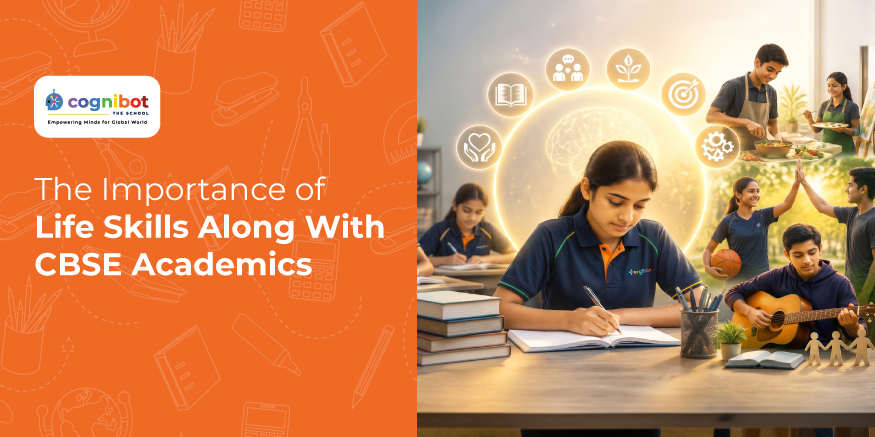
The Importance of Life Skills Along With CBSE Academics
Each parent has undoubtedly at one point in time asked him or herself if the constant emphasis on grades and rankings in the CBSE system is really preparing his or her child for the world he or she will be entering in the future. One may excel in all subjects but fail miserably at handling money, making clear communications during stressful times, settling differences with a peer or colleague, or making decisions where there is no obvious correct answer to find in any book.
This is perhaps the biggest concern of parents in India today concerning education, and it explains why life skills are important alongside CBSE academics in a way that nothing else has managed to do before.
What Life Skills Actually Encompass
Life skills are frequently talked about in such vague terms that it is easy for people to brush them off as a nice-to-have subject in a syllabus. In reality, life skills include a number of concrete abilities that can be learned, including financial acumen, communication, critical thinking, decision-making, time management, emotional control, conflict resolution, digital literacy, and more. These are not lofty values but tangible skills that help an individual deal with life’s ups and downs, whether within school or many years later.
Among the life skills every student should learn, financial skills certainly rank high due to the scarcity of knowledge imparted in traditional classroom settings in this regard. The importance of budgeting, the fundamentals of savings and investments, as well as the negative implications of incurring debt on one's future cannot be emphasised enough, yet CBSE students graduate with next to no experience of any of those.
Similarly, communication skills, whether oral or written, are a must for students aspiring to succeed in university interviews, workplaces, and life in general. Trigonometry and organic chemistry can only go so far here.
Why Academic Excellence Alone Falls Short
Despite the rigidity and rigour of the CBSE syllabus, the sole aim was that of imparting knowledge and equipping the learner to perform well under examination conditions. This, of course, is a valid aim, yet it is far too narrow in the context of what a youngster requires to succeed. An individual may have full marks in mathematics and yet be rendered immobile upon having to take part in a debate.
Another person may be brilliant in science yet incapable of dealing with their sibling or roommate over some minor differences without making things worse than they ought to be. Academic intelligence and life readiness are related but distinct capacities, and an education system that develops only the former leaves a meaningful gap in a student's overall preparation.
This gap is becoming evident as soon as the students get out of the confines of the school setup. Higher education, the world of work, and adult life require skills that one does not acquire from any school course, such as the ability to cope with uncertainty, self-regulation, financial management, and persuasive yet compassionate communication. The importance of life skills in modern education comes from the need to cover this gap before making any blunders that would cost the learner dearly without any preparation whatsoever.
The Documented Benefits of Life Skills Education
Both research and experience by teachers agree on the same effects being seen where life skills lessons are taken up seriously in education programs. These students can make sound decisions after undergoing the processes of working out difficult and confusing situations instead of facing them when the stakes are high later in their lives. The students have developed better emotional resilience since they have learned ways to deal with disappointment, stress, and setbacks.
The benefits of life skills education for students extend into measurable academic performance as well, somewhat counterintuitively. Students who manage their time effectively, regulate stress, and communicate confidently tend to perform better academically too, since these capacities directly support the focus, consistency, and confidence that strong academic performance requires. Far from competing with academic goals, life skills education tends to reinforce them, creating a more capable and self-directed learner rather than diverting attention away from coursework.
In addition to having positive implications for their careers and education, life skills training also gives students a boost in terms of personal development and confidence in themselves. A student equipped with the skills to deal effectively with money management, conflict resolution, and making rational decisions has the same sort of confidence that cannot be gained from merely doing well academically – that is, confidence in being able to handle life in general.
How Schools Can Effectively Teach Life Skills
Understanding how schools teach life skills education practically means understanding that life skills learning cannot simply be attained through random workshops or once-a-year seminars. Life skills education is just as important as other academic subjects and should therefore be provided in the same serious manner, by providing allocated time for learning and developing these skills.
The inclusion of life skills within the curriculum, instead of making them additional exercises, suggests that these life skills are important and will enable constant interaction with life skills. The availability of professional mentors, who not only have knowledge of child psychology but also know how to conduct meaningful discussions, becomes necessary since life skills cannot be learned theoretically but through discussions and experience.
Training for life skills conducted by employing the technique of projects and practicality, in which the students learn budgeting, negotiation, or conflict resolution within groups, is much more effective.
Family participation plays a very important role in enhancing this process. The life skills acquired at home through discussions and assignments tend to get internalised much better than the life skills that are taught only at school. Schools that help establish this link will see better results from their students since they have made sure not to leave everything to themselves.
Why This Matters More Than Ever in Today's World
The pace of change across technology, the job market, and society more broadly means that today's students will face a future considerably less predictable than the one their parents navigated. Careers will likely require more frequent adaptation, financial decisions will grow more complex, and the ability to think critically and communicate effectively across diverse contexts will only become more valuable as automation reshapes the nature of available work. A curriculum that prepares students exclusively for examinations, without equipping them for this broader reality, leaves them only partially ready for what lies ahead.
This is not an argument against academic rigour, which remains genuinely essential. It is an argument for recognising that academic and life skills development are not competing priorities but complementary ones, and that the strongest educational models are those that pursue both with equal seriousness rather than treating one as a luxury to be addressed only once the other has been secured.
At Cognibot, this conviction shapes how we have built our entire educational approach around the Proposed CBSE curriculum.
Our SMAART program introduces students in Grades 6 to 10 to subjects like financial mathematics, economics, and psychology alongside cutting-edge fields such as AI and robotics, ensuring that practical life competencies develop in parallel with academic depth. Through Sampoornatha, conducted five days a week as a structured subject in its own right, students build decision-making, responsibility, and conscious living skills under the guidance of mentors trained specifically in child psychology.
Our Trayoda C framework further develops thirteen specific human competencies, from financial literacy and communication to cognitive flexibility and conscious consumption, treating these as measurable, trainable skills rather than incidental outcomes. We believe that strong CBSE academics and genuine life readiness are not separate pursuits but two halves of a single, complete education, and everything about how we structure a student's day at Cognibot reflects that belief.
Conclusion
The need for integration of life skills education along with CBSE academic studies has shifted way past being a theoretical discussion into an issue that both parents and educators can relate to based on their observations. While the importance of excelling academically cannot be overstated, there is now a growing understanding among parents and educators that academic excellence alone is inadequate in equipping one for adulthood, success in a career, and happiness.
Schools that place equal importance on life skills education as they do on academic education and integrate the former into the curriculum are those best poised to turn out students who have received both academic and life training.