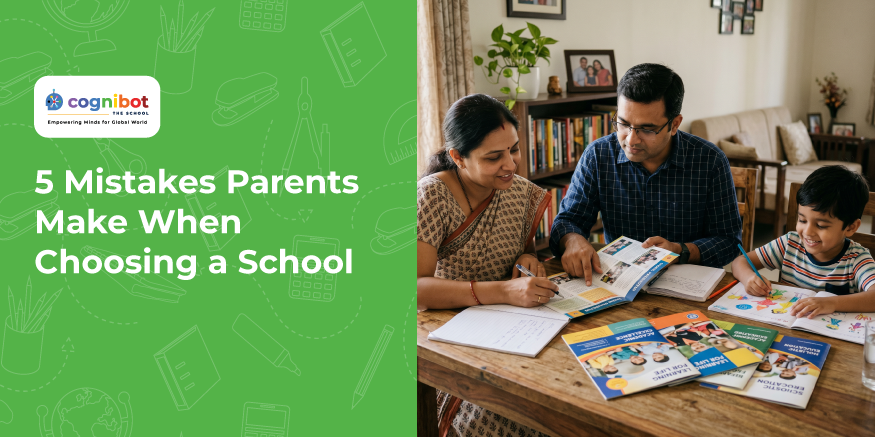
5 Mistakes Parents Make When Choosing a School
Choosing a school often starts with visible signals: board results, campus size, transport, safety, activities, and reputation. These matter, but they do not always reveal how a child will actually learn, think, communicate, or grow inside that environment.
Many parents make the decision based on what looks impressive from the outside. The harder question is whether the school builds curiosity, confidence, cognitive flexibility, emotional resilience, and independent thinking over time.
Somewhere in all that, there’s a child who just needs the right place to grow. And sometimes, without realizing it, parents fall into patterns that make the decision harder than it needs to be. These are the kind of mistakes parents make when choosing a school that don’t seem obvious at first, but slowly matter more over time.
That is why understanding the common mistakes parents make when choosing a school can help families make a calmer, clearer decision.
Mistake One: Mistaking High Marks for Meaningful Learning
There’s a natural pull toward schools that show high scores and top ranks. It feels safe, almost reassuring. The problem begins when marks become the only evidence parents trust. A child is not just a report card, and learning is not just about exams. What often gets missed here is how a child learns, not just what they score. Curiosity, confidence, the ability to ask questions, these don’t always show up in percentages.
A high-scoring environment is valuable only when it also builds conceptual clarity, problem-solving ability, and application-oriented thinking. In future-ready education, the real measure is not whether a child remembers the answer, but whether they can explain, apply, question, and transfer that knowledge to a new situation.
Marks do matter, but they should not be the only proof of learning. A strong school also helps children apply concepts, explain their thinking, ask better questions, and connect classroom lessons with real situations. This is where competency-based learning and application-oriented teaching become important.
When thinking about how to choose the right school for your child, it helps to pause and wonder what kind of learner the child might become in that space, not just what marks they might get. At Cognibot The School, we’ve seen how learning changes when it moves beyond marks. Our SMAART Program and Sampoornatha curriculum quietly shift the focus toward skills, thinking, and balance, not just outcomes on paper.
Mistake Two: Confusing Popularity With Personal
There’s comfort in choosing what others are choosing. If many parents are picking a certain school, it must be right. Or at least, it feels less risky that way. But children are not all moving in the same direction. A school that works beautifully for one child might feel uncomfortable for another. This is one of those things to consider when choosing a school that often gets overlooked. The environment, the pace, even the way teachers interact, it all lands differently for different children. At Cognibot The School, we often meet parents who come in after trying what “everyone else” suggested. What they usually say is simple, they just want a place where their child feels seen, not compared.
Before following another parent’s recommendation, it helps to visit the campus, observe how teachers speak to students, understand the curriculum approach, and ask how the school supports different learning styles. The best school is not always the most popular one. It is the one where the child’s personality, pace, and potential are understood.
Mistake Three: Treating The Campus As A Background, Not A Learning System
Sometimes the focus stays inside the classroom, subjects, books, teachers. But a child’s day is much bigger than that. It includes playgrounds, conversations, activities, quiet moments, and even distractions. An environment shapes behavior in ways that aren’t always visible immediately. This is where factors to consider when choosing a school quietly expand beyond academics.
We’ve chosen to create a 100% mobile-free childhood at Cognibot The School, not as a rule, but as a way to protect attention and presence. Add to that our open playgrounds, creative studios, and spaces like The Fit Sphere, and something shifts. Children begin to move, create, and interact more naturally. It’s not about keeping them busy. It’s about giving them space to grow in ways that don’t feel forced.
Mistake Four: Choosing Buildings Before Understanding The Teaching Culture
It’s easy to look at buildings, facilities, and curriculum charts. They are visible, easy to compare. But teachers, they are different. Their impact is quiet but lasting. A good teacher doesn’t just explain lessons. They notice things, small changes in mood, hesitation, curiosity. They guide without making it feel heavy. Yet, in many decisions, this part is assumed rather than explored.
Among the more subtle school selection tips for parents, paying attention to how teachers interact can change everything. Not just what they teach, but how they respond. At Cognibot The School, our faculty are not just selected, they are reoriented with a shared vision. This creates a certain consistency, a kind of understanding that children pick up on without needing it explained.
Parents should ask how teachers give feedback, how they handle doubt, how they support shy learners, and how they encourage classroom participation. A school’s teaching culture is visible in small moments: whether students are allowed to question, whether mistakes are treated as learning opportunities, and whether teachers notice individual progress.
Mistake Five: Calling Skill-Building Activities ‘Extra’
There’s often a point where school becomes all about preparing for the future. But in doing that, the present sometimes gets ignored. Childhood becomes structured, scheduled, and a little too serious. But learning isn’t only in books. It’s in games, in art, in music, in moments of teamwork and even failure. This is one of the most common mistakes parents make when choosing a school, thinking extracurriculars are “extra.”
Extracurricular activities are not a break from learning. They build communication, teamwork, discipline, leadership, and emotional resilience. A child who performs on stage, plays a team sport, practises yoga, or solves a chess problem is also learning focus, patience, and confidence.
At Cognibot The School, they aren’t extra. They are part of the learning itself. Whether it’s a child finding rhythm in the music hall, confidence on the stage, or focus through chess and yoga, these experiences build self-belief, social confidence, and resilience in ways that classroom learning alone may not. The 43,000 sq. ft. playground, the dance studio, the indoor games halls, they’re not just facilities. They’re places where children discover parts of themselves that classrooms alone cannot reveal.
Where Cognibot The Schools Begins To Feel Different
At Cognibot The School, the focus is not only on what children study, but on how they think, question, collaborate, move, create, and build confidence. The SMAART Program, Sampoornatha curriculum, mobile-free environment, creative studios, open playgrounds, and teacher-led mentoring work together to support whole-child development.
This is where the school selection conversation becomes larger than marks, infrastructure, or popularity. It becomes a question of future readiness: will the school help a child become curious, resilient, expressive, and independent?
Final Thoughts
Choosing the right school is not about finding the most popular name or the most impressive brochure. It is about understanding where your child will learn with confidence, stay curious, build skills, and feel supported every day.
For parents comparing the factors to consider when choosing a school, the real question is simple: will this environment help my child grow academically, socially, emotionally, and creatively? At Cognibot The School, that balance sits at the heart of every learning experience.