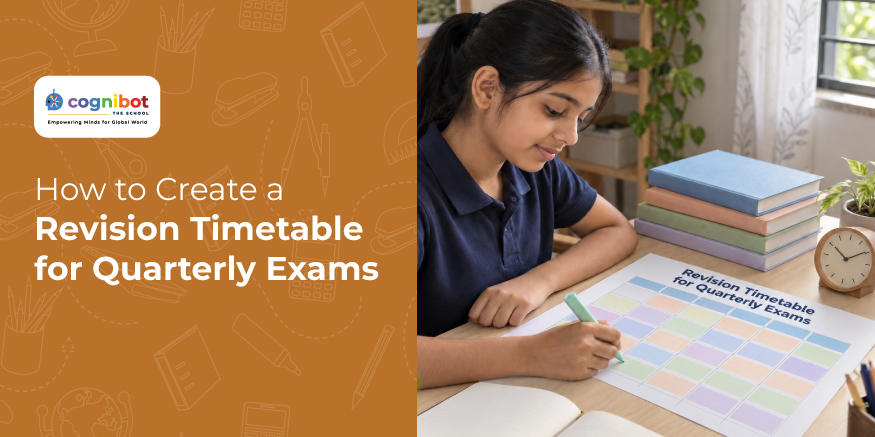
How to Create a Revision Timetable for Quarterly Exams
Quarterly exams are often the first major academic assessment of the school year. For students, they can feel challenging because several subjects need to be revised within a limited amount of time. Without a clear plan, students may spend too much time on one subject and leave others until the last minute.
A simple revision timetable for exams can make this process easier. It helps students divide their syllabus into smaller sections, set realistic study goals and make time for regular revision.
The goal is not to study for long hours every day. It is to study consistently, understand the topics and revise them at the right time.
Why Is a Revision Timetable Important?
A timetable gives students a clear idea of what they need to study each day. Instead of asking, "What should I study today?", they can simply follow the plan.
A good timetable can help students:
- Cover the syllabus systematically
- Give enough time to difficult subjects
- Avoid last-minute studying
- Include regular revision
- Track their progress
- Make time for breaks and sleep
- Feel more prepared before an exam
A well-planned study timetable for exams can also reduce unnecessary stress because students know what needs to be completed and when.
Step 1: Know Your Exam Schedule
The first step in how to create a revision timetable for exams is to understand the exam schedule.
Write down:
- Each subject
- Exam date
- Chapters included
- Topics that need more attention
- Topics that have already been studied
- Topics that still need to be completed
For example, if Mathematics is the first exam, students should give themselves enough time to revise Mathematics before moving on to the next subject.
Having the exam dates in front of you makes it easier to decide how much time should be given to each subject.
Step 2: List the Complete Syllabus
Before creating the timetable, make a subject-wise list of all chapters and topics.
For example:
Mathematics
- Fractions
- Algebra
- Geometry
- Mensuration
Science
- Plants
- Matter
- Energy
- Human body
Social Studies
- History
- Geography
- Civics
This makes the syllabus look more manageable. Instead of thinking about the entire textbook, students can focus on one topic at a time.
Step 3: Identify Strong and Weak Areas
Not every subject requires the same amount of time.
A student may be comfortable with English but find Mathematics difficult. In this case, Mathematics should receive more time for revision.
Divide topics into three categories:
Easy: Topics the student already understands well.
Moderate: Topics that need some revision and practice.
Difficult: Topics that require more explanation, practice or help.
This is one of the most useful exam preparation tips for students because it prevents them from spending equal amounts of time on topics that have very different learning needs.
Step 4: Divide the Syllabus Into Smaller Sections
Trying to complete an entire subject in one day can become tiring. Instead, divide chapters into smaller sections.
For example, instead of writing:
Monday – Mathematics
write:
Monday
- Mathematics: Algebra – Concepts
- Science: Matter – Revision
- English: Grammar – Practice
This makes the task more specific and easier to complete.
Small goals can also give students a sense of progress as they move through their syllabus.
Step 5: Create a Realistic Daily Schedule
A study timetable for exams should fit the student's normal routine.
Students should consider:
- School hours
- Travel time
- Homework
- Meals
- Sleep
- Sports and activities
- Breaks
- Family time
There is no need to fill every free hour with studying. A timetable that is too demanding may be difficult to follow.
For example:
| Time | Activity |
|---|---|
| 4:30–5:00 PM | Rest and snack |
| 5:00–5:45 PM | Mathematics |
| 5:45–6:00 PM | Break |
| 6:00–6:45 PM | Science |
| 6:45–7:15 PM | Outdoor activity |
| 7:15–8:00 PM | English |
| 8:00–8:30 PM | Dinner |
| 8:30–9:00 PM | Quick revision |
The exact timings can change based on the student's age, school schedule and daily responsibilities.
Step 6: Use Different Study Methods
Revision does not always mean reading the textbook repeatedly.
Students can use different methods depending on the subject.
For Mathematics, solving problems can be more useful than simply reading formulas.
For Science, students can make short notes, diagrams and concept maps.
For Social Studies, timelines, key points and question-answer practice can help.
For languages, reading, writing, grammar exercises and vocabulary practice can be included.
Using different methods keeps revision active and helps students check whether they actually understand the topic.
Step 7: Include Revision More Than Once
One of the common mistakes students make is revising a topic only once.
A better approach is to revisit important topics several times.
For example:
Day 1: Learn the topic
Day 3: Quick revision
Day 7: Practice questions
Before exam: Final revision
This approach gives students multiple opportunities to recall what they have learned.
At Cognibot – The School, the Read, Revise, Practice (RRP) approach focuses on reading lessons, reinforcing learning through revision and applying concepts through practice. The school's academic approach also emphasises conceptual understanding and independent learning.
Step 8: Keep Practice Tests in the Timetable
A revision plan should not only include reading and reviewing chapters. Students should also practise answering questions.
Set aside time for:
- Textbook questions
- Worksheets
- Sample papers
- Previous question papers, where available
- Short self-tests
- Writing answers within a time limit
Practice tests can show students which areas still need attention.
After completing a test, students should check their mistakes and add those topics to their next revision session.
Step 9: Keep a Doubt List
Students often come across questions or concepts they do not understand while revising.
Instead of spending too much time getting stuck on one question, they can maintain a small "doubt list."
The list could include:
- Difficult formulas
- Unclear concepts
- Questions they answered incorrectly
- Words they do not understand
- Chapters that need another explanation
They can then ask a teacher, parent or classmate for help.
This also makes revision more focused because students know exactly what they need to clarify.
Step 10: Plan the Final Few Days Carefully
The final days before the quarterly exams should focus mainly on revision and practice rather than learning everything from the beginning.
Students can use this time to:
- Revise important concepts
- Review notes
- Practise questions
- Revisit difficult topics
- Take short mock tests
- Memorise important formulas or definitions
- Review previous mistakes
Avoid starting several new topics on the night before an exam. A calm review of familiar material is usually more useful than trying to cover too much at the last moment.
How to Prepare for Quarterly Exams Without Stress
Knowing how to prepare for quarterly exams is not only about creating a timetable. Students also need healthy study habits.
Take Regular Breaks
Studying continuously for several hours can make it harder to stay focused. Short breaks between study sessions allow students to rest and return with better attention.
Get Enough Sleep
Late-night studying may seem productive, but students need proper rest to stay focused and remember what they have learned. Sleep should be treated as part of exam preparation, not as something to sacrifice.
Keep Distractions Away
Phones, television and constant notifications can interrupt study sessions. Keeping distractions away during study time can help students finish tasks faster.
Cognibot – The School follows a mobile-free approach and promotes a distraction-free learning environment. Its academic model combines Cambridge and Proposed CBSE curricula with programs such as SMAART, while its facilities include dedicated science, mathematics, computer and AI learning spaces.
Eat Well and Stay Active
Students should also make time for meals, physical activity and relaxation. Exam preparation should be balanced rather than focused only on books.
How Cognibot – The School Supports Academic Preparation
A supportive school environment can make exam preparation easier for students.
Cognibot – The School in Patancheru, Hyderabad, caters to students from Nursery to Grade 10. We offer the Cambridge Curriculum from Nursery to Grade 5 and proposed CBSE from Grades 6 to 10. The school also provides customized textbooks up to Grade 7, designed around curriculum goals and student needs.
Its academic approach focuses on conceptual understanding, critical thinking and independent learning rather than relying only on rote memorisation. The RRP approach of Read, Revise and Practice is particularly relevant when students are preparing for quarterly exams because it encourages regular review and application of concepts.
Cognibot also conducts Chapter End Tests from Class 6 to track progress and identify areas where students may need more support.
This kind of regular academic practice can help students approach exams as part of their learning process rather than as a last-minute challenge.
A Simple Weekly Revision Plan
Students can also create a weekly revision timetable for exams instead of planning every day in detail.
For example:
Monday: Mathematics + Science
Tuesday: English + Social Studies
Wednesday: Mathematics + Language
Thursday: Science + Social Studies
Friday: Mathematics + English
Saturday: Difficult topics + Practice test
Sunday: Weekly revision + Light study
The schedule can be changed depending on upcoming exam dates and individual learning needs.
Final Thoughts
A good revision timetable does not need to be complicated. It simply needs to tell students what to study, when to study it and when to revise it again.
The key to effective quarterly exam preparation is consistency. Start early, divide the syllabus into smaller sections, give more time to difficult topics and include regular practice.
Most importantly, students should remember that exams are a way to understand what they have learned and where they need more practice. With a simple plan and steady effort, quarterly exams can become much more manageable.
FAQ
1. How many hours should students study for quarterly exams?
There is no fixed number. Study time should depend on the student's age, syllabus, school schedule and learning needs. Focus on quality and consistency rather than long hours.
2. When should students start preparing for quarterly exams?
It is better to start revision a few weeks before the exams instead of waiting until the last few days. Regular revision makes the workload easier to manage.
3. What should a revision timetable include?
It should include subjects, chapters, revision sessions, practice tests, breaks and enough time for sleep and other activities.
4. How can students stay consistent with their study timetable?
Set small daily goals and keep the timetable realistic. Completing manageable tasks every day is easier than following an overly demanding schedule.
5. Should students study difficult subjects first?
Difficult subjects can be given more time, especially when the student is fresh and focused. However, the timetable should still include a balance of different subjects.