How Robotics and AI Build Teamwork, Creativity, and Leadership in Children
Technology is now part of nearly everything we do, and children today are growing up surrounded by Artificial Intelligence (AI) and robotics. As a parent, you might wonder how these technologies will affect your child's education and if learning about them early really matters.
AI and robotics are more than just computers or coding. They help children build important life skills like teamwork, creativity, leadership, problem-solving, and critical thinking. These skills will help them succeed in their future jobs and in daily life.
This is why many schools are going beyond traditional lessons and bringing in technology through hands-on activities.
Why Are AI and Robotics Important in School Education?
Children will grow up in a world that is very different from ours. While technology will handle many routine tasks, qualities like creativity, teamwork, communication, and leadership will always be important.
Learning AI and robotics in school doesn't mean every child will become an engineer. It's about helping them understand technology and giving them the confidence to use it in creative and responsible ways.
When children learn by doing instead of just reading about technology, they become active learners who like to explore, try new things, and solve problems.
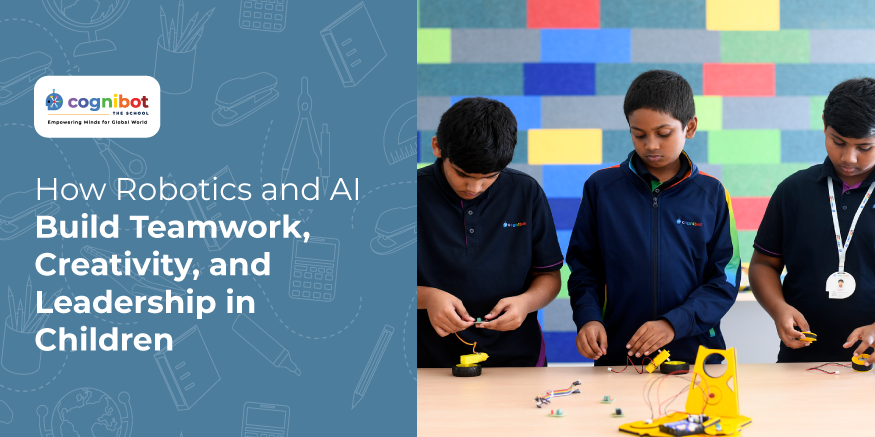
Robotics Makes Teamwork a Natural Part of Learning
Building a robot is rarely a one-person task.
Children team up to share ideas, solve problems, and finish projects together. Each student brings something different, some like designing, others focus on coding, and some lead the testing and improvements.
Through these experiences, children naturally learn how to:
- Listen to different ideas.
- Share responsibilities.
- Work towards a common goal.
- Respect different opinions.
- Support one another during challenges.
These teamwork skills are useful not just in school, but also in their personal lives and future careers.
AI Encourages Children to Think Creatively
Some people think AI just gives answers, but in education, it can help children ask better questions.
Instead of memorising information, students begin exploring different solutions. They start looking for different ways to solve problems. They learn that there can be more than one solution to a challenge.
- Explore different possibilities.
- Test new ideas.
- Learn from mistakes.
- Build confidence in their own thinking.
Creativity grows when children are given the freedom to experiment. Children become more creative when they can try new things without worrying about making mistakes. Children learn concepts better when they experience them.
Reading about robotics in a textbook teaches the basics, but building and testing a real model helps children understand much more.
Hands-on learning helps students:
- Remember concepts for longer.
- Stay curious and engaged.
- Build confidence through practical experience.
- Improve observation and analytical skills.
- Develop patience while solving problems.
Learning is more exciting when children see what they can achieve through their own efforts.
Robotics Is More Than Just Technology
One of the biggest misconceptions about robotics is that it's only about machines. In reality, robotics combines several important areas of learning.
Children use:
- Science to understand how things work.
- Mathematics to calculate measurements and patterns.
- Technology to build and programme.
- Creativity to design solutions.
- Communication to explain their ideas.
- Teamwork to complete projects successfully.
This way of learning helps children see how different subjects fit together and makes learning more meaningful.
Preparing Children for the Future Starts Today
The careers our children will have in the future may not even exist today. That's why schools need to prepare students for more than just exams. Along with strong academic knowledge, children need skills that help them adapt to change, think independently, and keep learning throughout their lives.
Whether they become engineers, entrepreneurs, scientists, or artists, they will benefit from being able to think critically, solve problems, work with others, communicate effectively, and use new technology with confidence.
This is why many parents today look for schools that offer not only academic excellence but also future-ready learning that helps children succeed in a rapidly changing world.
How Robotics Builds Leadership Skills
Children build leadership through experience, and robotics gives them many chances to do this. By working on projects, students learn to share ideas, take responsibility, solve problems together, and support each other. These experiences help them become confident and responsible leaders.
Building Confidence Through Problem-Solving
Robotics teaches children that making mistakes is normal when learning. If something doesn't work, they learn to find the problem, make changes, and try again. Some of the most important problem solving skills include:
- Patience
- Critical thinking
- Resilience
- Problem-solving skills
Skills That Last a Lifetime
AI and robotics help children build skills they will use throughout their lives, including:
- Teamwork
- Creativity
- Communication
- Leadership
- Critical thinking
- Adaptability
These skills help children get ready for both their future jobs and everyday life.
Why Cognibot?
At Cognibot, students learn AI and robotics through hands-on activities that spark curiosity, creativity, and teamwork. Along with strong academics, they build communication, leadership, and problem-solving skills in a supportive setting. This helps children become confident learners who are ready for the future and enjoy learning.
Final Thoughts
AI and robotics are more than just technology. They help children build confidence, creativity, teamwork, and leadership skills for a changing world. By mixing hands-on learning with strong academics, Cognibot prepares children for both future careers and lifelong success.
FAQ
How is AI affecting kids' creativity?
AI can help children be more creative by letting them explore ideas, solve problems, and make new things. When used well, it encourages imagination instead of replacing it.
Why is robotics important for kids?
Robotics helps children build problem-solving, critical thinking, creativity, teamwork, and technology skills through fun, hands-on activities.
How does robotics use AI to help children with disabilities?
AI-powered robotics can help children with disabilities by making learning easier. It offers personalized help, interactive tools, and technology that supports communication and movement.
How can learning robotics build teamwork and leadership skills?
Robotics projects encourage children to learn and explore several projects and encourage them to work together, share ideas, solve problems, and take on different tasks. This helps them build teamwork, communication, and leadership skills.