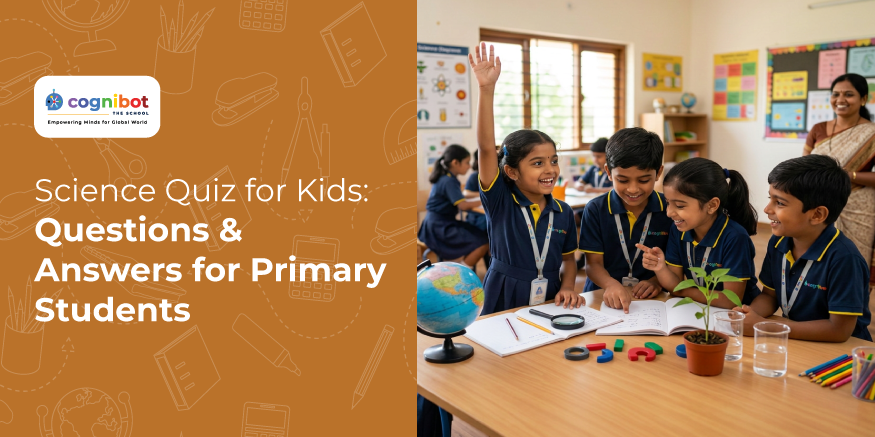
Science Quiz for Kids: Questions & Answers for Primary Students
Science is all around us. From the food we eat and the air we breathe to plants, animals, space, weather and our own bodies, children come across science every day. A science quiz is a simple and fun way to help primary students learn these ideas, remember important facts and become more curious about the world.
Instead of learning science only from textbooks, children can use quizzes to test what they already know and discover something new. These science quiz questions can be used at home, in classrooms, during school activities or even as a fun family challenge.
Below are 100 science quiz questions with answers for primary students. They cover basic topics such as the human body, animals, plants, Earth, space, matter, weather and everyday science.
100 Science Quiz Questions with Answers
Human Body
- Q: What organ pumps blood around the body?
A: The heart. - Q: How many eyes does a healthy human usually have?
A: Two. - Q: Which organ helps us think?
A: The brain. - Q: What do we use to breathe?
A: Our lungs. - Q: How many teeth does a typical adult have?
A: 32. - Q: What is the largest organ of the human body?
A: The skin. - Q: Which body part helps us hear?
A: The ears. - Q: Which part of the body helps us see?
A: The eyes. - Q: What carries oxygen around our body?
A: Blood. - Q: Which sense helps us identify smells?
A: The sense of smell.
Plants
- Q: What do plants need from the Sun to make food?
A: Sunlight. - Q: Which part of a plant usually grows underground?
A: The roots. - Q: Which part of a plant makes food?
A: The leaves. - Q: What gas do plants take in from the air?
A: Carbon dioxide. - Q: What gas do plants release during photosynthesis?
A: Oxygen. - Q: What do seeds grow into?
A: New plants. - Q: Which part of a plant attracts bees and butterflies?
A: Flowers. - Q: What do plants need to grow besides sunlight?
A: Water, air and nutrients. - Q: What is the process by which plants make their food?
A: Photosynthesis. - Q: Which part carries water from the roots to other parts of a plant?
A: The stem.
Animals
- Q: Which animal is known as the largest land animal?
A: The elephant. - Q: Which animal is called the king of the jungle?
A: The lion. - Q: What is a baby dog called?
A: A puppy. - Q: What is a baby cat called?
A: A kitten. - Q: Which bird is known for its colourful feathers and ability to mimic sounds?
A: The parrot. - Q: Which animal gives us wool?
A: Sheep. - Q: Which animal is famous for changing its colour?
A: The chameleon. - Q: Which animal is the fastest land animal?
A: The cheetah. - Q: Which sea animal has eight arms?
A: The octopus. - Q: Which animal is known for having a long trunk?
A: The elephant.
Earth and Environment
- Q: What planet do we live on?
A: Earth. - Q: How much of Earth's surface is covered mostly by water?
A: About 71%. - Q: What is the layer of air around Earth called?
A: The atmosphere. - Q: What do we call water falling from clouds?
A: Rain. - Q: What is frozen water called?
A: Ice. - Q: What causes day and night?
A: Earth's rotation. - Q: What do we call a large area covered mainly by trees?
A: A forest. - Q: What should we do with waste that can be used again?
A: Recycle it. - Q: What is the main source of energy for Earth?
A: The Sun. - Q: What do we call a sudden shaking of the ground?
A: An earthquake.
Space
- Q: What is the closest star to Earth?
A: The Sun. - Q: What is Earth's natural satellite?
A: The Moon. - Q: Which planet is known as the Red Planet?
A: Mars. - Q: Which is the largest planet in our solar system?
A: Jupiter. - Q: Which planet is famous for its rings?
A: Saturn. - Q: How many planets are in our solar system?
A: Eight. - Q: What do astronauts travel in to reach space?
A: Spacecraft. - Q: What is a group of stars forming a pattern called?
A: A constellation. - Q: Does the Moon make its own light?
A: No. It reflects sunlight. - Q: What force keeps planets moving around the Sun?
A: Gravity.
Matter and Everyday Science
- Q: What are the three common states of matter?
A: Solid, liquid and gas. - Q: What happens to ice when it gets warm?
A: It melts. - Q: What happens when water is placed in a freezer?
A: It freezes. - Q: What gas do humans need to breathe?
A: Oxygen. - Q: Is milk a solid or a liquid?
A: Liquid. - Q: Is a stone a solid or a liquid?
A: Solid. - Q: What happens when water is heated to a high temperature?
A: It changes into steam. - Q: Can we see air?
A: No, but we can feel its movement. - Q: What force pulls objects toward Earth?
A: Gravity. - Q: What do we use to measure temperature?
A: A thermometer.
Weather
- Q: What instrument measures temperature?
A: A thermometer. - Q: What instrument measures rainfall?
A: A rain gauge. - Q: What do we call moving air?
A: Wind. - Q: What do dark clouds often indicate?
A: Rain or a storm may be coming. - Q: What is a flash of light during a storm called?
A: Lightning. - Q: What sound usually follows lightning?
A: Thunder. - Q: What appears in the sky when sunlight passes through raindrops?
A: A rainbow. - Q: What season is usually the coldest?
A: Winter. - Q: What season is usually the hottest?
A: Summer. - Q: What do we call water vapour that cools and forms tiny drops?
A: Condensation.
Simple Science Around Us
- Q: Why do we need food?
A: For energy, growth and health. - Q: Why should we drink water?
A: Our bodies need water to function properly. - Q: Why do shadows form?
A: When an object blocks light. - Q: What gives us light during the day?
A: The Sun. - Q: What helps us see objects in the dark?
A: A source of light, such as a lamp or torch. - Q: What happens when we push a ball?
A: It moves. - Q: What helps a bicycle stop?
A: Brakes. - Q: Why do we wear woollen clothes in winter?
A: They help keep our bodies warm. - Q: Why do we wash our hands before eating?
A: To remove germs and reduce the spread of illness. - Q: What helps plants stay upright?
A: Their stems and supporting structures.
More Fun Science Questions
- Q: Which sense organ helps us taste food?
A: The tongue. - Q: Which sense organ helps us feel touch?
A: The skin. - Q: Which bird cannot fly but can swim very well?
A: The penguin. - Q: Which mammal can fly?
A: The bat. - Q: What do bees collect from flowers?
A: Nectar and pollen. - Q: What do fish use to breathe underwater?
A: Gills. - Q: What is the hard outer covering of a turtle called?
A: A shell. - Q: Which planet is closest to the Sun?
A: Mercury. - Q: Which planet is known for its thick clouds and very hot surface?
A: Venus. - Q: What shape is Earth approximately?
A: Roughly spherical. - Q: What do we call animals that eat only plants?
A: Herbivores. - Q: What do we call animals that eat other animals?
A: Carnivores. - Q: What do we call animals that eat both plants and animals?
A: Omnivores. - Q: What is a scientist who studies animals called?
A: A zoologist. - Q: What is a scientist who studies plants called?
A: A botanist. - Q: What is the study of weather called?
A: Meteorology. - Q: What is the study of stars and planets called?
A: Astronomy. - Q: What do magnets attract?
A: Certain metals, especially iron and steel. - Q: Can sound travel through air?
A: Yes. - Q: Why is asking questions important in science?
A: It helps us explore, investigate and understand how things work.
Why Science Quizzes Are Useful for Children
A quiz is more than a way to check whether a child remembers an answer. Good science quiz questions with answers can encourage children to think, recall information and connect classroom lessons with things they see every day.
For example, learning about plants becomes more interesting when a child notices leaves, flowers and roots in the garden. Learning about space can lead to questions about the Moon, stars and planets. Simple experiments can also help children see how concepts work instead of only reading about them.
Science quizzes can also make revision less stressful. Parents can ask a few science questions and answers for kids during car rides, family time or after school. Teachers can use them as warm-up activities or quick classroom challenges.
Making Science Learning More Practical
Children often understand science better when they get opportunities to observe, ask questions and try things themselves. This is where the learning environment and teaching approach matter.
At Cognibot - The School, science learning includes hands-on experiments and inquiry-based discovery. Its Cambridge Primary Programme focuses on science through practical exploration, while the school also has a dedicated science lab for experiments in physics, chemistry and biology.
Cognibot can therefore be a good choice for parents who want their children to learn science beyond memorising textbook answers. Our school encourages children to ask questions, explore ideas and connect learning with real-world situations. Its activity-based and experiential approach gives students opportunities to learn by doing and thinking.
For older students, Cognibot's SMAART Program also introduces areas such as Space Science, Astrobiology, Neuroscience, Robotics and other future-focused subjects, helping children explore science beyond the usual school syllabus.
Final Thoughts
Science becomes much more interesting when children are encouraged to ask “why?”, “how?” and “what if?”. A simple quiz can be a great starting point. These 100 science quiz questions with answers can help primary students revise basic concepts while making learning interactive and enjoyable.
The goal is not for children to know every answer immediately. It is to make them curious enough to look for the answer, understand it and ask the next question. That curiosity is what can turn science from another school subject into something children genuinely enjoy exploring.