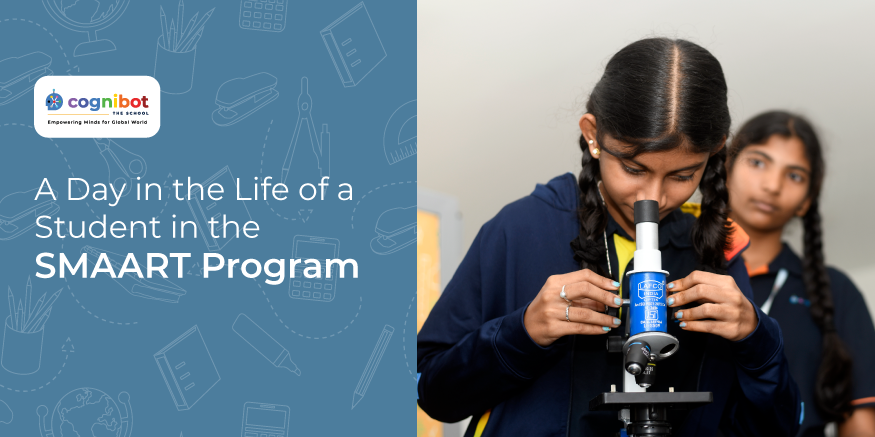
A Day in the Life of a Student in the SMAART Program
A regular day inside the SMAART program at Cognibot The School does not begin with grand announcements. It begins with students walking into classrooms where whiteboards are already filled with questions, robotics parts sit ready on tables, and laptops open for the first round of experiments.
A regular day inside the SMAART Program at Cognibot The School begins with whiteboards filled with half-solved problems, robotics parts arranged across tables, and laptops opening to lines of code from the previous session. Some students are already asking why a sensor failed yesterday. Others are comparing notes before class begins. The day has structure, but it also has movement: students question, test, build, debug, explain, and try again.
Morning Begins With Questions, Not Just Chapters
The morning may begin with a Science session, but it does not stay limited to a chapter. A teacher writes a question on the board: “Why do people react before they think?” Students begin with the structure of the human brain, then move into memory, emotions, and decision-making. Some sketch diagrams. Some compare examples from daily life. A few ask whether habits can be trained. The class becomes inquiry-driven without losing academic focus.
Another moment might bring up space, not as a distant idea, but as something students can actually go through questions. We at Cognibot The School don’t rush these moments. There’s space for wondering out loud, even if the answers aren’t clear right away.
Mathematics That Feels Like Solving Something Real
Mathematics here doesn’t stay on paper for too long. A problem might begin as numbers, but it slowly turns into something more thoughtful. Patterns, logic, even small puzzles that don’t have immediate answers.
Some students struggle at first. That’s expected. But over time, something changes. They begin to sit with the problem a little longer instead of looking for quick solutions. That patience, though quiet, becomes part of the learning. It’s less about getting it right quickly and more about understanding why it works at all.
One student, who once avoided mathematics because it felt intimidating, began staying back after a robotics session to understand why a sensor was not responding correctly. The solution was not immediate. It involved checking the code, measuring the distance again, and going back to the logic behind the command. By the end of the exercise, the student had not only solved the issue but had also understood why mathematical thinking mattered outside the notebook.
Technology That Isn’t Just a Subject
By the time students move into sessions focused on coding or data, the energy shifts again. Laptops open, code appears on screens, and errors show up almost immediately. One student checks a missing bracket. Another asks why the output is not matching the command. A group gathers around a screen, trying to debug the same problem from three different angles. On the board, the teacher maps the logic step by step until the mistake becomes visible.
Coding doesn’t come naturally to everyone, and that’s okay. What matters more is how students react when things don’t work. Some laugh, some get quiet, some try again without saying much. At Cognibot The School, we see this as learning in its most honest form. Not polished, not perfect, but real.
The room is rarely silent during coding sessions. Students call out possible fixes, compare outputs, and point at lines where the logic breaks. The teacher does not simply give the answer. They help students trace the error step by step, so the mistake becomes part of the learning process.
Break Time Still Carries The Morning’s Questions
During break, the school day loosens, but the conversations often continue. One table may still be talking about why the robot turned left instead of right. Another group may be discussing an AI example from class. Someone sketches a quick idea on the back of a notebook. These moments matter because they show curiosity retention. Students are not only completing tasks during class; they are carrying ideas with them after the bell rings.
Understanding People, Not Just Subjects
When students step into Applied Behavioural Studies, the focus shifts from external systems to human behaviour. They begin to ask why people make certain choices, how habits form, and how emotions affect decisions. This builds metacognition — the ability to think about one’s own thinking. It also helps students develop cognitive flexibility, because they learn that every problem has a human side, not just a technical one.
Hands That Build, Not Just Write
Robotics sessions are often the most visibly active. There’s movement, small discussions, and sometimes frustration when things don’t come together as planned. But that’s also where something important happens. Students learn to work with their hands, to test ideas, to fail and adjust without overthinking it. The learning here doesn’t stay in notebooks. It takes shape, sometimes literally.
AI And Cybersecurity Become Early Conversations
When students discuss artificial intelligence, they may begin with a simple question: how does a machine recognise a pattern? When cybersecurity enters the conversation, the examples may come from everyday online habits, passwords, privacy, or suspicious links. These topics are introduced in age-appropriate ways, so students build early digital awareness without feeling overwhelmed.
A School That Feels Thoughtful, Not Just Busy
By the time the day begins to wind down, it doesn’t feel like everything has been “completed.” And maybe that’s the point. There are still questions left open. Some ideas half-formed. Some concepts that will probably make more sense tomorrow. That unfinished feeling is not a problem. It’s part of the process. It’s also why many families slowly begin to see why Cognibot The School is often spoken of as the best international school in Patancheru, Hyderabad. Not because it tries to prove something, but because of how naturally it allows students to grow into their learning.
What Stays After the Day Ends
When students leave for the day, they may not carry perfect answers home. But they carry something more useful: a sharper question, a clearer way to solve a problem, or the confidence to try again after getting something wrong. Over time, these small habits shape independent thinking, communication, resilience, and curiosity retention.
How the SMAART Program Builds Future-Ready Skills
The SMAART Program builds future-ready skills through connected, application-based learning. Each area develops a different habit of mind:
- Science: builds inquiry and observation.
- Mathematics: strengthens logic and problem-solving.
- Robotics: develops testing, teamwork, and systems thinking.
- Coding: builds computational thinking and patience.
- Applied Behavioural Studies: supports metacognition, communication, and cognitive flexibility.
Closing Thought
A day in the SMAART program may still include classes, breaks, assignments, and routines. But beneath that routine, students are learning how to think with patience, curiosity, and purpose. They are not only preparing for the next exam. They are learning how to approach unfamiliar problems, work with others, and stay open to discovery. For Cognibot The School, that is the real value of education — not just covering what is known, but preparing students to think through what comes next.