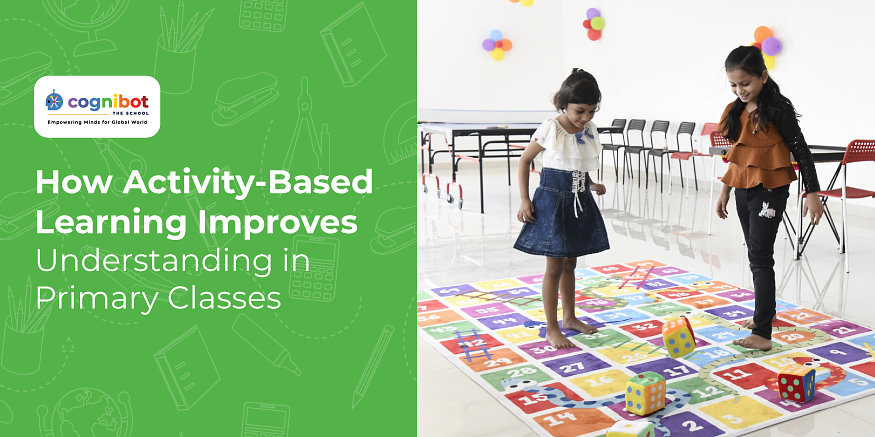
How Activity-Based Learning Improves Understanding in Primary Classes
Something changes in a classroom when children are asked to do something instead of just listening. The room gets louder, of course, and a bit messier too. But the noise is not random. It has a kind of direction to it. Children talk to each other, argue over small things, and sometimes get distracted. Still, they seem more involved than when they are quietly copying from a board. This is often what people mean when they talk about activity-based learning in primary classes. It sounds like a method, but it feels more like a shift in how learning happens. Instead of knowledge being handed over neatly, children sort of stumble into it. They test things, make mistakes, and circle back again. It doesn’t always look efficient, but understanding rarely does.
Why Sitting Still Isn’t Always Learning
In many primary classrooms, learning still follows a familiar pattern. The teacher explains, children listen, and then they write answers. Sometimes this works well enough, especially for memorising. But understanding is a quieter thing. It doesn’t always show up on the page right away. Young children especially seem to need something more concrete. Numbers make more sense when counted with actual objects. Words stick better when spoken, acted out, or connected to something real. Without that connection, lessons can float past without settling anywhere. That might be why experiential learning in primary school feels so natural. It aligns with how children already look at the world. They touch things, move things around, and ask questions that don’t always have neat answers. Learning through activity doesn’t interrupt that curiosity. It uses it. Sometimes it even depends on it. At Cognibot - The School, we see this every day in our classrooms, where children learn by doing, understanding, and questioning rather than just listening. This is one of the reasons families consider us among the best primary schools in Patancheru, Hyderabad.
The Slow Growth Of Understanding
Understanding rarely arrives all at once. It grows in pieces. A child measuring water in different containers might not immediately grasp the idea of volume. But something starts forming in the background. The next time the idea comes up, it feels slightly familiar. Activities seem to give knowledge somewhere to sit. A memory of doing something often stays longer than a memory of hearing about it. Even when the details fade, the experience leaves a kind of outline behind. It’s interesting how often children remember the activity but forget the explanation. Yet somehow the explanation makes more sense the second time. It’s as if the activity prepared a space for it. That preparation might be one of the quiet strengths of activity-based learning. It doesn’t rush understanding. It lets it take shape slowly.
When Learning Becomes Shared
Another thing that happens during activities is that learning stops being private. Children watch each other work things out. They copy ideas, improve them, or sometimes argue about them. In those small exchanges, thinking becomes visible. A child explaining something to a classmate often reveals more than a written answer ever could. There are pauses, wrong turns, and sudden realisations. The process shows itself in bits and pieces. That shared thinking seems to matter. It reassures children that confusion is normal. It also shows them that ideas can change. In quieter lessons, that part often stays hidden.
Structure Still Matters
Activity-based learning sometimes gets mistaken for unstructured time. But the best activities usually have careful planning behind them. Without that, things drift, and the learning becomes accidental. Some structured curricula, like the Cambridge Primary Programme, try to balance this by building activities around clear learning goals. The structure is there, but it doesn’t always sit on the surface. Instead, it guides what children understand and how those explorations connect back to the lesson.
This balance seems important. Too much structure and the activity becomes mechanical. Too little and the point gets lost somewhere along the way. Finding that middle space might be the real challenge. At Cognibot -The School, we design our learning experiences so that activities are always guided by clear outcomes, helping children build both confidence and understanding step by step. Our approach reflects what many parents look for in the best primary schools in Patancheru, Hyderabad.
Not Every Moment Needs An Activity
It’s easy to assume that more activity always means better learning, but that doesn’t quite hold up. Children also need time to pause and make sense of what they’ve done. Without that pause, activities can blur together. Sometimes, a short explanation after an activity suddenly ties everything together. Other times, a quiet worksheet helps settle ideas that were first discovered through play. The activity opens the door, but something else often helps organise what comes in. Learning seems to move back and forth like this. Action followed by reflection, then action again.
Also Read: Why and How Curiosity Plays a Pivotal Role in Learning
What Seems To Stay With Children
Years later, many people remember projects, experiments, and small classroom moments more clearly than ordinary lessons. The memory of building something or figuring something out tends to last. Maybe that’s because those moments involve more than just thinking. They involve movement, emotion, and sometimes even frustration. All of that seems to anchor the learning more firmly. This might be the simplest way to understand activity-based learning in primary classes. It gives learning more ways to stick, not just through words, but through experience.
Learning That Grows With Every Child
At Cognibot - The School, we believe learning should shape the whole child, not just academic results. With over two decades of educational legacy, we provide a balanced environment through our Sampoornatha approach, blending academics, values, and life skills. Our carefully designed spaces, experienced faculty, and global curriculum encourage curiosity and confidence in young learners. We also ensure a focused, mobile-free environment where children can truly engage with activities, ideas, and friendships. This commitment to meaningful learning is why many families consider us among the best primary schools in Patancheru, Hyderabad, where education is experienced, not just taught.
Final Thoughts
Activity-based learning doesn’t always look dramatic from the outside. It can be as simple as sorting objects, acting out a story, or measuring the length of a desk. Yet those small actions seem to change how lessons are understood. They turn ideas into something closer to experience. And experience tends to stay longer than explanation. Maybe that’s why experiential learning in primary school keeps returning to the conversation around education. It reflects something basic about how children make sense of things. They don’t just think about the world. They try it out first. And somewhere in that trying, understanding begins to form. Not perfectly or all at once, but steadily, piece by piece.