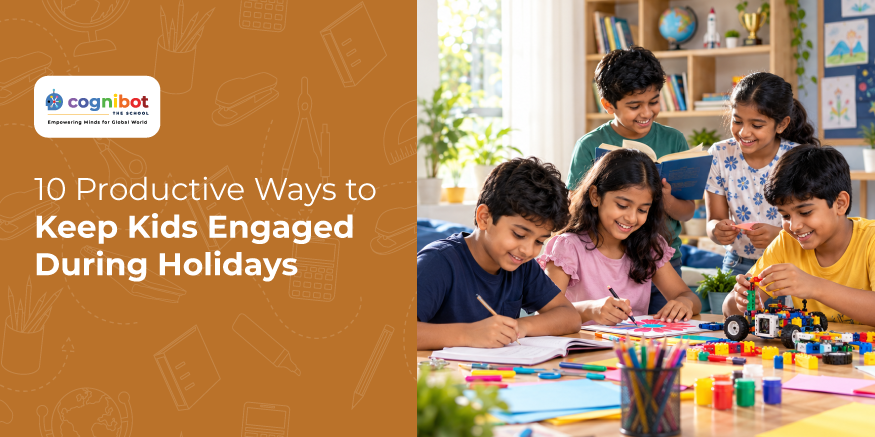
10 Productive Ways to Keep Kids Engaged During Holidays
School holidays give children a break from their usual routine. They get more time to sleep, play, spend time with family and explore things they may not have time for during the school term. But when the holidays stretch over several weeks, children can quickly become bored or spend too much time watching television and using mobile phones.
The solution is not to fill every hour with classes or homework. Children need time to relax, but they also benefit from activities that keep them curious, active, and involved. The right holiday activities for kids can help them learn new skills, build confidence, and enjoy their time away from school.
Here are ten simple ways parents can make the holidays enjoyable and productive without making them feel like another school term.
1. Encourage Reading Every Day
Reading is one of the simplest activities for children during holidays. It improves vocabulary, comprehension, imagination and communication skills. Children can explore storybooks, comics, biographies, science books or subjects that interest them.
Set aside 15–30 minutes for reading each day, depending on your child's age. Let them choose their own books instead of making reading feel like an assignment. Younger children can read picture books with a parent, while older children can maintain a list of books they finish.
You can also ask children to tell you about their favourite character or explain what they learnt from a story. This turns reading into an enjoyable conversation rather than a task to complete.
2. Turn Everyday Tasks into Learning Opportunities
Children do not have to sit with textbooks to learn something useful. Everyday activities can help them understand concepts they encounter in school.
For example, ask them to calculate the cost of groceries, measure ingredients while cooking or read instructions before assembling a toy. Younger children can sort objects by colour, shape or size, while older children can compare prices and calculate discounts.
These educational activities for children connect classroom learning with real-life situations. They also encourage children to ask questions, think independently and understand how their knowledge can be used outside school.
3. Introduce Simple Science Experiments
Children are naturally curious about how things work. Holidays are a good time to explore that curiosity through simple experiments at home.
Try growing a plant from a seed, making a paper bridge to test how much weight it can hold or observing how shadows change during the day. Older children can create a simple weather chart or learn about electricity through safe, age-appropriate experiments with adult supervision.
Encourage children to predict what might happen before starting an activity. After the experiment, ask what surprised them and why they think the result happened.
These fun learning activities for children during holidays help develop observation, problem-solving and critical-thinking skills. Always choose activities suitable for your child's age and supervise experiments involving heat, sharp objects or chemicals.
4. Make Time for Sports and Outdoor Play
Children need physical activity just as much as they need mental stimulation. Outdoor play helps them stay active, practise coordination and learn to work with others.
Depending on their interests, children can play cricket, badminton or football, ride a bicycle, go swimming with supervision or simply spend time at a nearby park. Indoor options such as dance, yoga and movement games can also help on days when outdoor play is not possible.
Team sports teach children to follow rules, handle wins and losses, and work towards a shared goal. Individual activities help them build patience and confidence.
Try to make movement part of the daily routine rather than something children do only when they have finished every other activity.
5. Let Children Explore Art and Craft
Drawing, painting, origami, clay modelling and DIY crafts give children an opportunity to express themselves. They also help develop fine motor skills, patience and creativity.
You do not need expensive materials to get started. Old cardboard boxes, newspapers, paper rolls and leftover craft supplies can become useful materials for a project.
Ask your child to create a greeting card, design a bookmark or build a model of their favourite place. Let them make their own choices instead of expecting every project to look perfect.
Among the many productive activities for kids during holidays, creative projects are especially useful because they give children the freedom to experiment, make mistakes and try again.
6. Introduce Children to Coding, Robotics and Technology
Children are surrounded by technology, but using a device is different from understanding how it works. Holidays can be a good time to introduce them to age-appropriate coding, robotics, digital design or basic computer skills.
Younger children can begin with simple logic games and block-based coding. Older children may enjoy building basic robots, designing a simple game or exploring how artificial intelligence works.
The goal is to help children create something rather than only consume digital content. Parents should choose safe, age-appropriate resources and balance screen-based learning with offline activities.
Schools such as Cognibot – The School place a focus on future-ready learning through areas such as AI, robotics, computing and its SMAART programme. Its approach combines academic learning with skills that encourage curiosity, creativity and problem-solving. Parents looking for a school that introduces children to emerging technologies can explore Cognibot's academic programmes.
7. Give Children Small Responsibilities at Home
Holidays are a good time for children to learn practical life skills. Simple responsibilities can help them become more independent and understand the importance of contributing to family life.
Younger children can organise their toys, water plants or help set the table. Older children can prepare a simple snack with supervision, organise their school supplies or help plan a family outing.
Start with one or two age-appropriate tasks instead of giving children a long list of chores. Appreciate their effort and allow them to learn at their own pace.
These activities teach responsibility, time management and decision-making. They also show children that learning is not limited to books or classrooms.
8. Explore Music, Dance and Other Hobbies
Children may discover new interests when they have time to try different things. Holidays are an opportunity to explore music, dance, gardening, photography, storytelling or learning a new language.
Give children the chance to try an activity before deciding whether they want to continue. They may enjoy learning a musical instrument, practising a dance routine or creating a small garden more than they expected.
Avoid enrolling them in too many classes at once. The idea is to help them discover what they enjoy, not to turn every free hour into a scheduled lesson.
9. Create a Simple Holiday Routine
A routine gives children structure without taking away their freedom. It can include time for reading, outdoor play, hobbies, family activities and rest.
You could let your child help plan the week. For example, Monday might be for a craft project, Tuesday for a science experiment and Wednesday for a visit to the library or park.
Keep the plan flexible. Children do not need to complete every activity every day, and there should be enough unplanned time for them to relax or follow their own interests.
A balanced routine makes holiday activities for kids easier to manage while helping children develop independence and time-management skills.
10. Make Family Time Part of the Learning Experience
Some of the most meaningful learning happens when children spend time with their families. Cooking together, visiting a museum, exploring a local market or listening to grandparents share stories can introduce children to new ideas and experiences.
You can also plan a family quiz, board-game evening or a day when everyone learns something new. Encourage children to ask questions, share their opinions and explain what they discover.
Cognibot's Sampoornatha and broader TRISHUL approach emphasise personal development, reflection, values and meaningful family connections alongside academic learning. This reflects an important idea: education should help children grow as people, not only prepare them for examinations. You can read more about the school's learning philosophy.
How Cognibot – The School Supports Learning Beyond Textbooks
Keeping children engaged during holidays is easier when learning is treated as more than memorising lessons. Children benefit when they have opportunities to explore ideas, develop life skills, play and discover their interests.
Cognibot – The School in Patancheru, Hyderabad, focuses on future-ready education alongside personal development. Its programmes include Cambridge learning for Nursery to Grade 5, a proposed CBSE curriculum for Grades 6 to 10, and the SMAART programme, which introduces students to areas such as science, mathematics, advanced computing, robotics and technology. The school also highlights extracurricular opportunities and a mobile-free childhood. Explore Cognibot – The School.
For parents, the key takeaway is simple: children need a mix of learning, movement, creativity, family time and rest. A school that values these different areas can help build habits that continue well beyond the holidays.
Conclusion
Holidays do not have to be packed with classes to be productive. Reading a book, growing a plant, playing a sport, trying a craft or helping with a family meal can all give children something useful to learn. The best activities are those that match their interests, suit their age and leave them wanting to explore more.
As parents, focus on giving children opportunities rather than expecting perfect results. With a little planning and plenty of room for play, the holidays can help children return to school feeling refreshed, curious and ready to learn.
FAQ
1. What should students include in a quarterly exam revision plan?
Students should list the subjects and chapters they need to revise, mark topics they find difficult and set small daily goals. The plan should include time for practice questions, reviewing mistakes and revisiting important concepts. It should also leave room for hobbies, physical activity and rest.
2. How can students divide their revision time between subjects?
Students can give more time to subjects or topics they find difficult while keeping up regular practice in subjects they understand well. Short study sessions with clear goals are often easier to follow than long sessions without breaks. The schedule should be adjusted according to the syllabus and exam dates.
3. How far in advance should students start preparing for quarterly exams?
Starting two to three weeks before the exams can give many students enough time to revise steadily, depending on the syllabus and their current understanding. Students should begin earlier if they have several chapters to cover or need additional help with certain topics. Regular revision throughout the term can make exam preparation less stressful.
4. How can breaks make exam revision more effective?
Short breaks help students rest, stretch and return to their work with better attention. After a focused study session, children can take a brief walk, drink water or do a simple activity. Breaks should be refreshing rather than turning into long periods of screen time that make it harder to return to studying.
5. What are some ways to stay focused while following a revision timetable?
Students can study in a quiet space, keep their phones away, set one clear goal for each session and use a checklist to track progress. Alternating subjects and taking regular breaks can also help. Parents can support children by maintaining a calm routine without putting too much pressure on them.