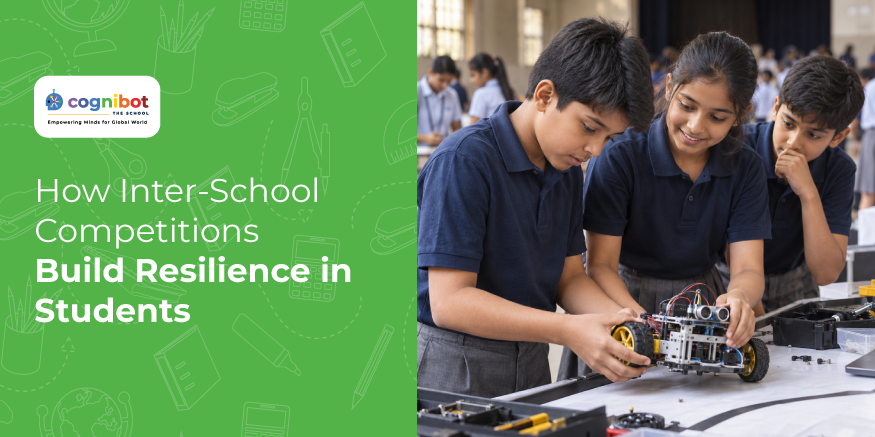
How Inter-School Competitions Build Resilience in Students
Winning a competition feels great, but the real value of inter-school competitions goes beyond winning. These experiences give children a chance to face challenges, deal with pressure, work with others, accept mistakes, and try again.
Whether it is a sports tournament, debate, quiz, science competition, music event, dance performance, or robotics challenge, competing with students from other schools can teach children lessons that are difficult to learn from textbooks alone.
For parents and schools, these competitions can be an important part of helping children become confident and resilient individuals.
What Is Resilience in Children?
Resilience is the ability to deal with difficulties, recover from setbacks, and continue trying.
For a student, resilience could mean:
- Trying again after losing a competition
- Staying calm when things do not go as planned
- Learning from mistakes
- Accepting feedback
- Handling pressure
- Not giving up when something feels difficult
- Understanding that failure does not define their ability
Children do not develop resilience overnight. It develops through experiences where they face challenges and learn how to handle them.
Inter-school competitions can provide many such opportunities.
1. Competitions Teach Children to Handle Failure
One of the biggest lessons competitions teach is that you cannot always win.
A student may prepare for weeks and still lose. A team may perform well but finish second. A participant may forget an answer during a quiz or make a mistake during a performance.
These experiences can be disappointing, but they also provide an opportunity to learn.
With the right guidance, children can start asking:
What went wrong? What can I improve? What can I do differently next time?
This changes the way they look at failure. Instead of seeing it as the end, they begin to see it as part of learning.
2. They Help Children Step Outside Their Comfort Zone
It is easy for children to stay with activities they already feel comfortable doing.
Competitions encourage them to try something different.
A child who is nervous about public speaking may participate in a debate. A student who loves science may take part in a science exhibition. Someone who enjoys sports may represent their school in a tournament.
Standing in front of unfamiliar students, teachers, and judges can be challenging at first.
But every such experience can make the next one a little easier.
3. Competitions Teach Children to Handle Pressure
Competitions often involve deadlines, preparation, practice, and performance expectations.
Students may have to complete a project within a particular time, answer questions quickly, perform in front of an audience, or play an important match.
Learning to stay focused under pressure is a useful life skill.
It can later help students deal with college entrance exams, interviews, presentations, workplace responsibilities, and other challenging situations.
4. They Build Confidence Through Experience
Confidence does not always come from winning.
A student can become more confident simply by participating.
The first time a child speaks on stage, they may be nervous. After participating several times, they may become more comfortable.
The same applies to sports, debates, music, art, science projects, and other competitions.
Every attempt gives children another opportunity to discover what they can do.
5. They Teach Teamwork
Many inter-school competitions require students to work as a team.
Sports are an obvious example, but teamwork is also important in quizzes, robotics, science projects, theatre, music, and other activities.
Students learn that everyone has a different role.
They have to listen to teammates, share responsibilities, communicate clearly, solve disagreements, and work towards a common goal.
These are skills that children will need long after they leave school.
6. They Help Children Accept Feedback
Judges, coaches, and teachers may point out areas where a student can improve.
For some children, criticism can be difficult to accept.
Competitions provide an opportunity to teach children how to listen to feedback without taking it personally.
A student can learn that feedback is not an attack. It is information that can help them improve.
This mindset can become valuable in academics, relationships, and future careers.
7. Competitions Teach Preparation and Discipline
Success in most competitions does not happen through last-minute preparation.
Students need to practise, research, revise, rehearse, or train.
This teaches them the connection between consistent effort and improvement.
For example, a student preparing for a debate needs to research the topic, understand different viewpoints, practise speaking, and prepare for questions.
Similarly, an athlete needs regular practice rather than training only before a tournament.
These experiences help children understand the value of preparation and discipline.
8. They Develop Decision-Making Skills
Competitions often require children to make decisions quickly.
A sportsperson may need to decide what move to make. A quiz participant may need to choose an answer under time pressure. A robotics team may need to find another solution when something does not work.
These situations encourage children to think, evaluate their options, and act.
Over time, such experiences can strengthen independent decision-making.
9. They Help Children Become More Adaptable
Things do not always go according to plan during a competition.
A presentation may not work as expected. A teammate may be absent. A piece of equipment may stop working. A question may be completely different from what a student prepared for.
Children learn to adjust.
This ability to adapt when circumstances change is an important part of resilience.
10. They Build Emotional Strength
Competitions can bring excitement, nervousness, disappointment, pride, and even frustration.
Learning to manage these emotions is an important part of growing up.
A child needs to learn how to stay calm after making a mistake, manage nervousness before performing, and handle disappointment after losing.
With support from teachers and parents, these experiences can help children develop better emotional control.
How Cognibot – The School Supports This Development
At Cognibot – The School, learning extends beyond academics. The school's approach focuses on developing critical thinking, creativity, emotional resilience, communication, leadership, and other skills that children need for the future. Its TRISHUL framework brings together SAMPOORNATHA, TRAYODA 'C, and SANGAM, with an emphasis on human skills, emotional resilience, values, and independent thinking.
The school also provides extensive opportunities for students to participate in sports and extracurricular activities. Its 43,000 sq. ft. playground supports activities including cricket, basketball, volleyball, pickleball, badminton, football, and skating. The school also has dedicated spaces for dance, music, yoga, and other activities.
Importantly, Cognibot's 4,100 sq. ft. auditorium is used for events including theatrical performances and inter-school competitions, giving students opportunities to showcase their abilities and build confidence in front of an audience.
Its academic approach also supports resilience. The Cambridge Curriculum emphasizes critical thinking, creativity, independent learning, adaptability, and resilience, while the school's proposed CBSE program includes activities that encourage students to learn from mistakes and develop independent thinking.
How Parents Can Support Children After Competitions
Parents have an important role to play too.
Instead of asking only:
"Did you win?"
Try asking:
- What did you learn?
- What was the most difficult part?
- What are you proud of?
- What would you do differently next time?
- Did you enjoy participating?
- What did you learn from the other students?
This shifts the focus from the result to the experience.
Children should know that winning is exciting, but losing is not something to be ashamed of.
Final Thoughts
Inter-school competitions give children a safe environment to experience challenges, pressure, teamwork, failure, and success.
They teach students that improvement takes practice, mistakes are part of learning, and setbacks do not mean they should stop trying.
Most importantly, competitions help children develop a mindset that can support them far beyond school.
The goal is not to raise children who win every competition. It is to raise children who know how to keep going when they don't.
FAQ
1. 1. How do school competitions support student development?
School competitions help students develop confidence, teamwork, communication, problem-solving, discipline, and the ability to handle both success and failure.
2. 2. What are some competitions for school students?
Students can participate in sports, debates, quizzes, spelling bees, science exhibitions, coding, robotics, art, music, dance, and public speaking competitions.
3. 3. How do extracurricular activities benefit students?
Extracurricular activities help children discover their interests, develop new skills, stay active, improve social skills, and become more confident.
4. 4. What are the benefits of inter-school competitions for students?
Inter-school competitions expose students to new experiences and different levels of competition. They help build confidence, teamwork, discipline, adaptability, and a healthy competitive spirit.
5. 5. How do extracurricular activities build resilience?
They allow students to face challenges, make mistakes, handle disappointment, and try again. Over time, this helps them become more comfortable with failure and setbacks.
6. 6. What is the role of competitions in student development?
Competitions give students opportunities to apply what they learn, perform under pressure, work with others, and learn from both wins and losses. They support development beyond academics.